Thank you for visiting nature.com. You are using a browser version with limited support for CSS. To obtain
the best experience, we recommend you use a more up to date browser (or turn off compatibility mode in
Internet Explorer). In the meantime, to ensure continued support, we are displaying the site without styles
and JavaScript.
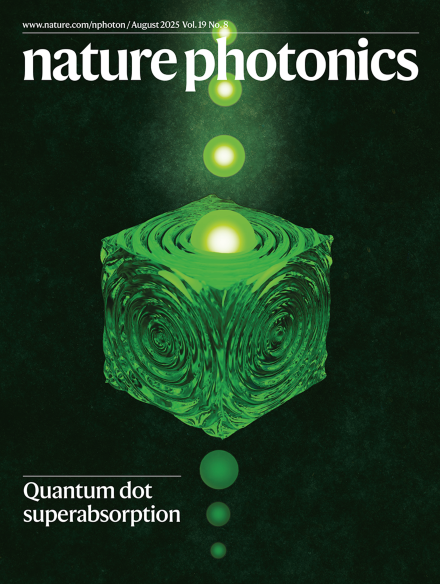
Enhanced ‘superabsorption’ of single photons by large CsPbBr3 perovskite quantum dots is observed at cryogenic temperatures. The effect, attributed to a giant oscillator strength through spatially extended coherent oscillations of the electron polarization, opens the way to more efficient light–matter interactions.
The fast and convenient study of ion channels in cells continues to pose challenges. Interferometric scattering microscopy delivers robust signals from single channels, paving the way for label-free investigation of their function in live cells.
Guiding light is an essential task in optics, from optical fibres to compact nanoscale systems. Here, a few-atoms-thin MoTe2 layer embedded into a planar waveguide emits photons into waveguide modes that propagate coherently, paving the way for waveguide quantum electrodynamics with van der Waals materials.
A spectrally and polarization-resolved wavefront detector can measure the spatio-temporal vector electric field of ultrashort laser pulses in a single shot.
This Review reports the recent progress in utilizing van der Waals layered materials in various nanophotonics applications and provides an overview of their future developments in hybrid and tunable nanophotonics, 3D photonic structures, optical trapping, polariton devices and van der Waals integrated nanophotonic circuits.
The generation of spatiotemporal optical vortices in the extreme-ultraviolet regime is demonstrated via high harmonic generation. Topologically coupled at the nanometre and attosecond domains, these light beams are attractive for exploring electronic dynamics in magnetic materials, chiral media and nanostructures.
Ultrathin multilayer van der Waals material stacks are shaped into precisely engineered resonant nanostructures, giving strong nonlinearities at ultralow fluences of <1 nJ cm–2, more than three orders of magnitude smaller than in previous two-dimensional-material-based cavity systems.
A nano-optical probe of the Purcell effect in a van der Waals waveguide is demonstrated, exploiting its highly confined infrared waveguide modes and the capacity for infrared emission in the monolayer limit of atomically layered van der Waals materials.
Chirality-induced quantum non-reciprocity of cross-channel correlations is demonstrated in a rubidium vapour system by flipping the flow direction of one of the circularly polarized laser beams. It can be extended to multicolour sidebands with Floquet engineering.
The researchers demonstrate direct measurement and complete characterization of structured electronic wave packets created within a prototypical Fano resonance. The method may be broadly applicable to the study of ultrafast processes, especially electronic ones, in complex systems, as well as coherent control of such systems on their fundamental timescales.
An ultra-thin mixed-reality (MR) display design that is based on a unique combination of waveguide holography and artificial intelligence-driven holography algorithms is demonstrated, creating visually comfortable and perceptually realistic 3D VR experiences in a compact wearable device.
Greatly enhanced light absorption is reported in large perovskite quantum dots by realizing a transition with a giant oscillator strength at the optical bandgap.
Electrochemical modulation enables iSCAT microscopy to detect the electrical activity of live cells by localizing and identifying different types of ion channels down to the single-channel level and imaging frame rates up to 1.5 kHz.
A high-peak-power low-duty-cycle pulsed fibre laser enables stimulated Brillouin scattering microscopy with pixel dwell times as low as 0.2 ms and spatial resolution as low as 500 nm and 2 μm in the lateral and axial directions, respectively.
A reconstruction method for image scanning microscopy exploits all the information encoded in the four-dimensional image scanning microscopy dataset to achieve optical sectioning and maintain super-resolution and high-signal-to-noise-ratio imaging.
A single-shot full-vector-field measurement technique for intense, ultrashort laser pulses is studied, demonstrating the approach on systems ranging from high-repetition-rate oscillators to petawatt-class lasers.