
Thank you for visiting nature.com. You are using a browser version with limited support for CSS. To obtain the best experience, we recommend you use a more up to date browser (or turn off compatibility mode in Internet Explorer). In the meantime, to ensure continued support, we are displaying the site without styles and JavaScript.

Volume 19 Issue 7, July 2025

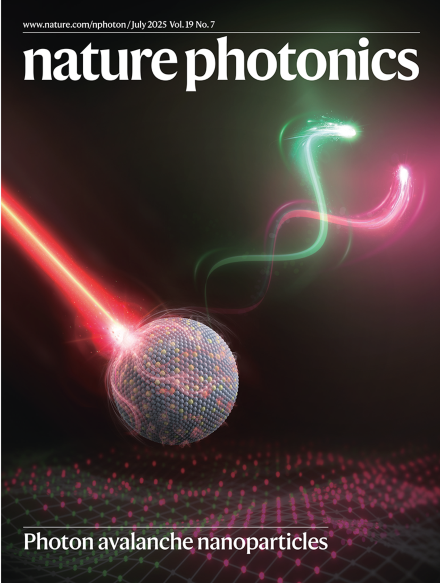
Photon avalanche nanoparticles

An artistic illustration of dual-wavelength photon avalanche emissions from a nanoparticle. By leveraging the dual-level configuration of holmium ions, red and green parallel photon avalanche emissions can be generated simultaneously under single-wavelength near-infrared excitation, enabling multicolour sub-diffraction microscopy.

See Dong et al.

Image: Hao Dong, Ling-Dong Sun, Chun-Hua Yan, Peking University. Cover design: Bethany Vukomanovic
News & Views

  • Optical micro-printing provides a way to directly self-assemble photonic microchips with chiral liquid-crystalline photonic elements.

    • Shunsuke Takano
    • Toru Asahi
    • Ivan I. Smalyukh
    News & Views

    Advertisement

  • Programmable nonlinearities — including control over the response order up to high orders — can now be realized on-chip at ultralow power via field programmability. This advance paves the way for more scalable and energy-efficient photonic computing in applications such as machine learning, optical signal processing and communications, analogue computing and quantum photonics.

    • Fei Xia
    News & Views
  • Holmium-doped nanoparticles exhibit a novel parallel photon avalanching mechanism, offering controlled chromaticity and enabling sub-diffraction, multicolour bio-imaging upon excitation with a single near-infrared laser.

    • Artur Bednarkiewicz
    News & Views
  • Quantum light is shown to perturb strong-field interactions in solids, revealing photon bunching in high-harmonic sidebands. The generation of attosecond non-classical states opens up quantum-enhanced photonics in novel temporal and spectral domains.

    • Marcelo Ciappina
    News & Views
  • Attosecond pulses in the optical regime, formed as solitons during infrared laser-pulse compression in a hollow-core fibre, may open up attosecond science in molecules and solids.

    • Mette B. Gaarde
    News & Views
Top of page ⤴

Review Articles

  • The broad applications of emerging photonic technologies, such as photoacoustic imaging, optical wearable sensors, point-of-care testing and optogenetic control, in cardiovascular disease care are reviewed, together with the challenges of integrating these innovations into clinical practice.

    • Yuqi Zhou
    • Atsuhiro Nakagawa
    • Keisuke Goda
    Review Article
Top of page ⤴

Consensus Statements

Top of page ⤴

Articles

  • The introduction of sodium heparin passivates interface defects and enhances bonding between the electron transport layer and the perovskite layer in perovskite solar cells. The best-performing devices exhibit a certified PCE of 26.54% and maintain almost 95% of their initial performance after 1,800 h of maximum power point tracking.

    • Xiaodan Tang
    • Chenglin Yang
    • Xiaopeng Zheng
    Article
  • A turn-key-operable hybrid integrated Pockels laser based on an external distributed Bragg waveguide grating reflector fabricated in a wafer-scale thin-film lithium niobate on insulator platform is demonstrated, with a tuning efficiency of over 550 MHz V–1, tuning rates reaching the exahertz per second, and a high output power of 15 mW.

    • Anat Siddharth
    • Simone Bianconi
    • Tobias J. Kippenberg
    Article
  • Electrochemical modulation of fluorophores enables regulating their emission states, facilitating spectral unmixing of up to four fluorophores with similar spectral characteristics. This method is readily applicable to multicolour STED imaging, effectively expanding a single imaging channel to four channels.

    • Ying Yang
    • Yuanqing Ma
    • J. Justin Gooding
    Article Open Access
  • Field-programmable photonic nonlinearity is realized by controlling the spatial distribution of carrier excitations and their dynamic behaviour within an active semiconductor, advancing photonic computing and its integration with reconfigurable computing architectures.

    • Tianwei Wu
    • Yankun Li
    • Liang Feng
    Article
  • An ultra-compact, ultra-wide-bandwidth in-phase/quadrature modulator on a silicon chip is demonstrated, enabling coherent transmission for symbol rates up to 180 Gbaud and a net bit rate surpassing 1 Tb s−1 over an 80 km span, with modulation energy consumption as low as 10.4 fJ bit−1, and promising enhanced performance and scalability for future networking infrastructures.

    • Alireza Geravand
    • Zibo Zheng
    • Wei Shi
    Article
  • Intense squeezed light with focusable intensities of 0.1 TW cm2 is created by propagating a classical, intense and noisy input beam through an optical fibre. The noise 4 dB below the shot-noise level is achieved by selecting a set of wavelengths whose intensity fluctuations are maximally anticorrelated.

    • Shiekh Zia Uddin
    • Nicholas Rivera
    • Marin Soljačić
    Article
  • Combining advanced photonics with reconfigurable liquid crystalline self-assembled structures allows control of a liquid crystal’s microlaser emission by nanosecond optical pulses and the ability to switch off the laser emission from the liquid crystal using the resonant stimulated-emission depletion process, providing a design for a new class of photonic integrated devices.

    • Mahendran Vellaichamy
    • Uroš Jagodič
    • Igor Muševič
    Article Open Access
  • When high-harmonic emission from a ZnO crystal is perturbed with a bright squeezed vacuum beam, a comb of super-bunched high-order sidebands is created. This indicates photon bunching and the generation of a non-coherent state at the short wavelength.

    • Samuel Lemieux
    • Sohail A. Jalil
    • Giulio Vampa
    Article
  • Combining attosecond metrology and soliton dynamics in hollow-core fibres, the generation of attosecond laser pulses from the deep-ultraviolet to the near-infrared regime and the measurement of attosecond solitons with 350-as durations at optical wavelengths are demonstrated, providing an efficient route to generate intense isolated attosecond pulses complementary to those based on high-harmonic generation in gases.

    • Amelie M. Heinzerling
    • Francesco Tani
    • Nicholas Karpowicz
    Article Open Access
Top of page ⤴

Search

Quick links