
Thank you for visiting nature.com. You are using a browser version with limited support for CSS. To obtain
the best experience, we recommend you use a more up to date browser (or turn off compatibility mode in
Internet Explorer). In the meantime, to ensure continued support, we are displaying the site without styles
and JavaScript.
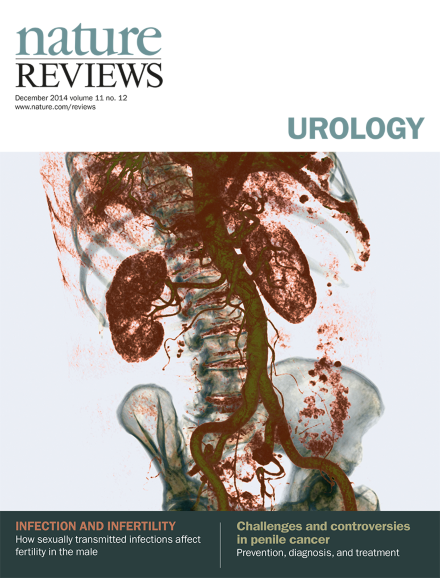
Cover image supplied by Arnulf Stenzl, Department of Urology, Eberhard-Karls-University Tuebingen, Tuebingen, Germany. Volume rendering is used for the reconstruction and 3D visualization of 2D images collected by CT or MRI. This image shows volume rendering of the abdominal aorta in a 73-year-old man who presented with severe flank pain and was subsequently diagnosed with renal atherosclerotic disease.
Lee et al. have highlighted the influence of surgical wait time on oncologic outcomes after surgery for upper-tract urothelial carcinoma (UTUC). The length of surgical wait time in UTUC should be <1 month for nephroureterectomy. Despite some limitations of the study, this message is important for clinicians in their daily practice.
Few prognostic factors have been identified and successfully replicated for patients with high-risk nonmetastatic castration-resistant prostate cancer (nmCRPC). However, a new report has shown that alkaline phosphatase velocity (APV) is an independent predictor of bone-metastasis-free survival and overall survival in patients with nmCRPC.
Multidiscliplinary teams (MDTs) are increasingly used to aid decision-making in the care of patients with cancer, but their clinical value can be difficult to quantify. A prospective study has now assessed the use of MDTs for patients with urological cancers. Future refinement of MDT organization is required to optimize effectiveness.
Evaluation of patient outcomes does not encompass all survivorship issues after prostate cancer treatment. Addressing the effect that these issues have on men's lives remains a great challenge; therefore, the American Cancer Society Prostate Cancer Survivorship Care Guidelines are a welcome addition to the medical literature.
Sexually transmitted diseases caused by bacteria, viruses and protozoa can affect the male genital tract. Gimenes and colleagues discuss the evidence for effects of sexually transmitted pathogens on semen, sperm and male infertility.
Extracellular vesicles mediate intercellular signalling and are potential sources of cancer biomarkers. Nawaz and colleagues describe the biogenesis of extracellular vesicles, and the methods available for their isolation and characterization. The authors also discuss current research into the identification of vesicle-derived biomarkers for cancers of the prostate, kidney and bladder.
Delayed diagnosis and treatment of penile cancer often result in the development of advanced disease. Shabbir et al. highlight how pooling resources and expertise can help improve disease management and review remaining challenges in prevention, diagnosis, treatment and lymph node staging.
New androgen-receptor-targeting drugs, such as enzalutamide, provide a substantial survival benefit for patients with castration-resistant prostate cancer, but treatment resistance has been reported. In this Perspectives article, Claessens and colleagues describe the mechanisms underlying the development of such resistance and discuss their clinical relevance.