
Abstract
This study examined how Marzano’s self-system thinking (SST) and a four-dimension operationalization of academic self-determination (ASD) relate to persistence in learning natural sciences (PLNS) and scientific-text reading fluency (RFT) among bilingual (Arabic–English) university students in Egypt. Using a cross-sectional correlational design, data were collected from 302 undergraduates (Mage = 21.1, SD = 1.39; 249 females, 53 males). SST was measured with adapted Likert scales assessing importance, efficacy, and emotional response, and ASD was assessed with adapted scales assessing academic autonomy, self-regulation, psychological empowerment, and self-realization. Scientific-text reading fluency was assessed using an individually administered oral reading task scored by trained raters (accuracy, expression/prosody, rate, and voice clarity/tone) alongside brief comprehension items. Multiple regression analyses were used to estimate the associations of SST and ASD with PLNS and RFT, including joint models to examine their incremental explanatory contribution when entered together. Both construct systems were significantly associated with PLNS and RFT. In dimensional analyses, SST emotional response and efficacy, and ASD psychological empowerment, showed the most robust associations across outcomes. Given the cross-sectional design, findings are interpreted as associations rather than evidence of causal effects. The results underscore the potential value of instructional and advising practices that support students’ affective engagement with science learning and their sense of academic agency in bilingual STEM-adjacent contexts.
Introduction
Bilingual university students’ success in the natural sciences is a high-stakes concern because science learning in many contexts is mediated through a second language and sustained engagement is required to cope with cognitively demanding texts, assessments, and laboratory discourse. In Egypt, Arabic–English bilingual undergraduates often navigate this dual burden: discipline-specific scientific literacy in English alongside local educational expectations and resource constraints. Yet, research in bilingual STEM-adjacent settings has rarely examined how cognitive–affective self-appraisals and agentic motivation operate together to explain two outcomes central to science success—persistence and scientific-text reading fluency.
This study addresses that gap by integrating Marzano’s self-system thinking (SST) with an agency-oriented operationalization of academic self-determination (ASD) grounded in Self-Determination Theory (SDT). SST foregrounds learners’ task-linked appraisals—what a task means to them (importance), what they believe they can do (efficacy), and how they feel when engaging with it (emotional response)—as proximal drivers of engagement and regulation during learning (Marzano, 1998; Marzano and Kendall, 2007). These components are especially consequential in science learning, where persistence often depends on emotional regulation under difficulty, tolerance of ambiguity, and sustained effort with dense, technical texts. In bilingual settings where performance is repeatedly filtered through L2 assessment demands, efficacy and emotional response may become particularly consequential for both persistence and reading performance (Tavakoli, 2012).
In parallel, SDT emphasizes that motivation and adaptive learning are strengthened when autonomy- and competence-supportive experiences sustain students’ agency (Deci and Ryan, 1985). However, “academic self-determination” has been operationalized in multiple ways across studies. To maintain conceptual alignment with SDT while capturing proximal agency mechanisms relevant to bilingual university learning, ASD is modeled here as enacted academic agency rather than as regulatory-style motivation alone. Specifically, ASD is operationalized via four dimensions: (i) academic autonomy (ownership/volition), (ii) academic self-regulation (planning/monitoring routines), (iii) academic psychological empowerment (perceived control/impact), and (iv) academic self-realization (internalized growth-oriented academic identity). This operationalization is framed as a functioning-oriented complement to SDT’s regulatory measures, not a substitute, and is consistent with evidence that SDT-related academic motivation can be represented via nuanced structural models (e.g., bifactor-ESEM; Litalien et al., 2017).
Because scientific learning is text-intensive, scientific-text reading fluency in English may function as a performance bottleneck that amplifies motivational and self-appraisal processes. Scientific reading—especially oral performance—imposes immediate cognitive load (technical vocabulary, syntactic density) and evaluative pressure that can heighten threat appraisals and disrupt pacing and monitoring (Tavakoli, 2012). Accordingly, this study examines how SST and ASD relate to (a) persistence in learning natural sciences (PLNS) and (b) scientific-text reading fluency (RFT) among bilingual Egyptian undergraduates.
Research Questions
-
1.
To what extent are self-system thinking (SST: importance, efficacy, emotional response) and academic self-determination (ASD: autonomy, self-regulation, psychological empowerment, self-realization) associated with (a) persistence in learning natural sciences (PLNS) and (b) scientific-text reading fluency (RFT) among bilingual (Arabic–English) university students in Egypt?
-
2.
When SST and ASD are modeled simultaneously, what is the incremental explanatory contribution of each construct system (ΔR²) to PLNS and RFT?
-
3.
In nested (hierarchical) comparisons, do SST and ASD differ in their incremental variance explained (ΔR²) for PLNS and RFT, and which dimensions show the most robust associations across outcomes?
Literature Review
Framing the problem: why persistence and scientific reading fluency co-matter in bilingual science learning
University science learning is unusually demanding because it requires sustained engagement with abstract concepts, cumulative knowledge, and dense disciplinary texts. For bilingual undergraduates studying in a second language, persistence is shaped not only by cognitive competence but also by learners’ self-beliefs, affective responses to difficulty, and agentic regulation of learning. In such contexts, scientific-text reading fluency is not a peripheral skill; it is often a throughput constraint that affects students’ ability to access content knowledge, keep up with coursework, and maintain motivation over time. Accordingly, a theoretically coherent account of bilingual science success should connect (a) how students appraise a task and their capability, (b) how they regulate and own their learning, and (c) how these processes relate to persistence and text-based performance.
Self-System Thinking as a cognitive–affective appraisal system in learning
Early scholarship on the “self-system” emphasizes that self-representations and self-schemas shape information processing, effort allocation, and persistence under challenge (Markus and Ruvolo, 1989). In motivation models associated with self-determination traditions, students’ internal appraisals (e.g., competence, autonomy, belonging) are treated as mechanisms that channel engagement and learning behavior (Connell and Wellborn, 1991). Building on these foundations, Marzano’s Self-System Thinking (SST) situates self-related appraisals as a front-end gate that determines whether learners invest effort in a given task (Bloom, 1956, 1968; Anderson and Krathwohl, 2001).
In Marzano’s formulation, SST is not simply “motivation” as a global trait; it is a set of task-linked appraisals that structure engagement in a learning situation (Marzano and Kendall, 2007, 2008; Colley et al., 2012; Irvine, 2017, 2020; Asmi et al., 2019; Greaterex et al., 2019; Yildirim, 2021). The components most relevant to academic persistence and text-based performance are:
-
Importance (task value/relevance): whether the learner sees the task as meaningful or worth effort;
-
Efficacy (capability appraisal): whether the learner believes they can succeed;
-
Emotional response (affective appraisal): anticipated feelings (e.g., anxiety, interest, frustration) associated with the task;
-
These appraisals jointly contribute to overall motivation as a decision to engage and continue (Marzano and Kendall, 2007).
Relevance to science learning
Science courses magnify the role of SST because they reliably trigger uncertainty, error-correction, and cognitive load. Under these conditions, (i) value judgments about whether science is “worth it,” (ii) efficacy beliefs about handling complex tasks, and (iii) emotional responses to challenge can determine whether students persist when encountering conceptual difficulty or dense scientific reading. Thus, SST is best treated as an appraisal-and-engagement system that is likely to align with persistence and performance in text-mediated science learning, rather than as an abstract taxonomy discussion.
Academic self-determination as agentic regulation in the learning context
Self-Determination Theory (SDT) argues that adaptive motivation is supported when individuals experience autonomy and competence in ways that foster internalized, self-endorsed engagement (Deci and Ryan, 1985; Liu et al., 2013; Cavusoglu and Karatas, 2015; Litalien et al., 2017; Holmquist et al., 2024; Núñez-Regueiro et al., 2024; Gunasekare, 2016). In academic settings, SDT-based research commonly links autonomy-supportive environments and competence beliefs to persistence, self-regulated learning, and well-being (Cavusoglu and Karatas, 2015; Holmquist et al., 2024; Katz et al., 2009; Liu et al., 2013; Litalien et al., 2017; Núñez-Regueiro et al., 2024; Gunasekare, 2016). Although SDT research most commonly operationalizes academic motivation via regulatory styles (e.g., intrinsic, identified, introjected, external, amotivation), the present study distinguishes between (i) motivation quality as measured in SDT instruments and (ii) students’ enacted academic agency as expressed through autonomy enactment, self-regulatory functioning, empowerment beliefs, and self-realization–oriented academic identity. Accordingly, ASD is treated here as an agency-oriented regulation profile rather than as a substitute for SDT’s motivational continuum.
To keep the model coherent and non-redundant, this study treats ASD not as a synonym for “motivation,” but as agentic enactment in learning: the extent to which students experience ownership, regulate their study behavior, and perceive themselves as capable of influencing outcomes. The four-dimension operationalization used here—academic autonomy, academic self-regulation, academic psychological empowerment, and academic self-realization—aims to capture how agency is enacted in academic life rather than how students appraise a single task. This emphasis on enacted agency provides a conceptual boundary from SST:
-
SST = task-linked appraisal system (importance/efficacy/emotion → readiness to engage).
-
ASD = agentic regulation system (ownership, regulation, empowerment, self-realization → sustained self-directed action).
This distinction matters because it prevents the manuscript from implying that SST and ASD are interchangeable predictors and responds to reviewers’ concerns about discriminant validity and construct redundancy.
The conceptual distinction between SST Efficacy and ASD Psychological Empowerment is evidenced by the scale items: while SST Efficacy captures the cognitive appraisal of a specific challenge (e.g., ‘I view difficult topics as a challenge rather than a threat’), ASD Psychological Empowerment captures the enacted sense of agency within the social academic environment (e.g., ‘My colleagues take my opinion into consideration’). This distinction justifies the inclusion of both construct systems as non-redundant predictors of science learning outcomes.
Persistence in science learning: moving beyond older trait-only accounts
This definition is consistent with persistence research in science education that emphasizes motivational, regulatory, and contextual supports for continuation and retention (Reason, 2005; Lavigne et al., 2007; Williams and George-Jackson, 2014; Hwang, 2024; Katsantonis et al., 2024; Ruiz-Alfonso et al., 2023; Peixoto et al., 2023; Whitehead et al., 2024). Earlier motivational and personality traditions describe persistence as a relatively stable tendency (e.g., effortfulness, ambition, perfectionism; Cloninger et al., 1993). While such trait perspectives can inform measurement, reviewers correctly noted that persistence scholarship has expanded toward more contemporary educational constructs such as academic resilience, growth-oriented beliefs, and sustained effort under difficulty (often discussed in relation to “grit”). These perspectives converge on a key point: persistence is not only “how hard a person works,” but also how learners regulate emotions and meaning under challenge and how they sustain agency over time.
Within this contemporary framing, growth mindset has been theorized as a resilience-supporting belief system that shapes how students interpret difficulty and persist under challenge, particularly when they view ability as developable rather than fixed (Yeager and Dweck, 2012). At the same time, the popularization of grit warrants careful handling: meta-analytic evidence suggests that grit’s incremental predictive value is often modest once conscientiousness and prior achievement are considered, cautioning against treating grit as a uniquely powerful explanatory construct (Credé et al., 2017).
This is precisely where SST and ASD become theoretically relevant to science persistence.
-
SST provides a mechanism for why students continue: they judge a task as valuable, believe they can succeed, and experience manageable affect.
-
ASD provides a mechanism for how students continue: they exercise autonomy, regulate study routines, experience empowerment, and interpret learning as self-realizing.
Conceptually, growth-oriented interpretations of challenge align with SST’s affective and efficacy appraisals, while critiques of grit underscore the value of focusing on specific, malleable mechanisms (e.g., emotional response, empowerment, self-regulation) rather than relying on broad trait labels (Credé et al., 2017; Yeager and Dweck, 2012). Accordingly, persistence in natural sciences is expected to align with both (i) appraisal-based engagement (SST) and (ii) agentic regulation (ASD), particularly in contexts where learning is mediated through a second language.
Scientific-text reading fluency as a performance bottleneck in bilingual science learning
Reading fluency is typically conceptualized as accurate, efficient word recognition combined with appropriate pacing and prosody, enabling readers to allocate cognitive resources to comprehension (Gough and Tunmer, 1986; Florit and Cain, 2011; Lonigan et al., 2018; Nation, 2019; Perfetti, 2007; Elleman and Oslund, 2019; Goldenberg, 2020; Feruzi, 2021). In science learning, the challenge is intensified by specialized vocabulary, dense information packaging, and syntactic complexity typical of scientific discourse (Sabatini et al., 2018; Shanahan and Shanahan, 2008). For bilingual undergraduates, scientific reading fluency is therefore consequential not only for comprehension but also for motivation maintenance: repeated breakdowns in decoding, speed, or expressive reading can increase frustration and reduce willingness to persist.
From the present study’s perspective, reading fluency is linked to SST and ASD through two plausible routes:
-
1.
Affective–appraisal route (SST): emotional response and efficacy appraisals can shape approach/avoidance tendencies toward demanding reading tasks and the tolerance needed to persist through difficulty.
-
2.
Agency–regulation route (ASD): students who self-regulate effectively and experience academic agency are more likely to engage in repeated practice, manage time-on-text, and persist through complex materials.
Prior evidence linking self-beliefs, agency, persistence, and reading outcomes
Across educational psychology, self-efficacy and perceived competence reliably relate to persistence and achievement in STEM contexts (Estrada et al., 2011; Sawtelle et al., 2012). Autonomy-supportive environments and competence-related beliefs are also associated with more self-determined patterns of academic engagement (Simon et al., 2015). In reading research, fluency is consistently linked to comprehension development and broader academic performance (Kim et al., 2021; Wang et al., 2019). Together, this literature supports a general proposition: students’ appraisals (can I do this? is it worth it? how will it feel?) and their enacted agency (do I regulate and own my learning?) relate to both persistence and text-based outcomes.
However, what remains less developed—particularly in bilingual university science settings—is an integrated account that treats SST and ASD as distinct but complementary systems and tests their joint associations with (a) domain-specific persistence (PLNS) and (b) scientific-text reading fluency in English. In addition, reviewers noted that claims of “very limited research” must be made precisely; therefore, the contribution is best framed not as “no one has studied motivation,” but as the more defensible claim that the combined examination of these specific construct operationalizations in this specific population and outcome pairing is under-characterized.
Research gap
In sum, prior work suggests that (i) appraisal-based self-beliefs are relevant to engagement and persistence (Marzano, 1998; Marzano and Kendall, 2007), (ii) SDT-consistent agency and self-regulation relate to academic persistence and adaptive engagement (Deci and Ryan, 1985; Liu et al., 2013, 2014), and (iii) reading fluency constrains comprehension and broader academic functioning in text-intensive disciplines (Duke and Cartwright, 2021; Kim et al., 2021; Sabatini et al., 2018). What remains under-characterized in bilingual university science settings is how task-proximal appraisals (SST) and domain-general enacted agency (ASD) operate together to explain both (a) sustained commitment to science learning (PLNS) and (b) scientific-text reading fluency (RFT). The present study addresses this need by treating SST and ASD as distinct but complementary systems: SST is expected to shape performance readiness and engagement thresholds under L2 science demands, whereas ASD is expected to support sustained self-directed routines and practice exposure that maintain persistence and enable fluency development. This integrated focus clarifies whether each system contributes unique explanatory value (ΔR²) when modeled jointly and identifies which dimensions remain robust when shared variance is controlled.
Figure 1 presents the conceptual framework guiding the analyses and clarifies construct boundaries: SST is modeled as a task-linked appraisal system (importance, efficacy, emotional response), whereas ASD is modeled as an agency-oriented regulation system (autonomy, self-regulation, psychological empowerment, self-realization). Figure 2 translates this framework into the analytic specification used in the Results, where SST and ASD are treated as parallel predictor sets for (a) persistence in learning natural sciences (PLNS) and (b) scientific-text reading fluency (RFT). Consistent with the cross-sectional design, arrows denote modeled associations and are not interpreted as causal pathways.
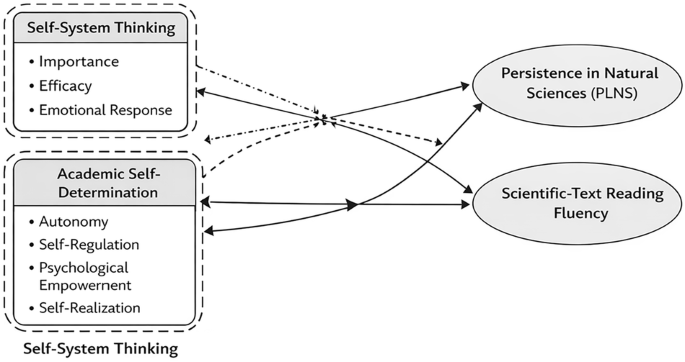
Self-system thinking (SST) is conceptualized as a task-linked appraisal system (importance/value, efficacy/capability appraisal, emotional response), whereas academic self-determination (ASD) is conceptualized as an agency-oriented regulation system (autonomy, self-regulation, psychological empowerment, self-realization). The figure motivates examining SST and ASD as distinct (non-redundant) correlates of persistence in learning natural sciences (PLNS) and scientific-text reading fluency (RFT) in a bilingual university context. (Main text.).
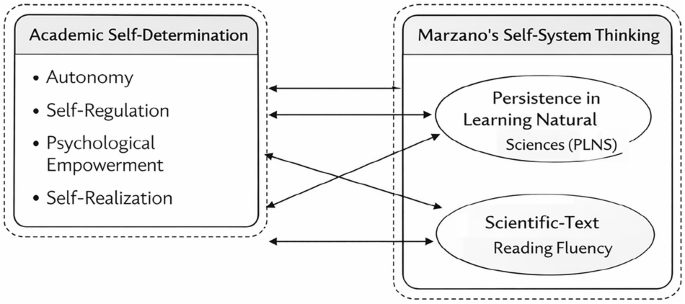
SST dimensions (importance, efficacy, emotional response) and ASD dimensions (autonomy, self-regulation, psychological empowerment, self-realization) are specified as parallel predictor sets in separate multiple regression models predicting PLNS and RFT. Arrows indicate modeled associations consistent with the cross-sectional design and are not interpreted as causal effects. This figure corresponds to the modeling strategy summarized in Tables 2 and 4 (model summaries) and the key standardized coefficients reported in Tables 3 and 5.
Self-system thinking (SST) is conceptualized as a task-linked appraisal system (importance/value, efficacy/capability appraisal, emotional response), whereas academic self-determination (ASD) is conceptualized as an agency-oriented regulation system (autonomy, self-regulation, psychological empowerment, self-realization). The figure clarifies the theoretical non-redundancy between SST and ASD and motivates examining their associations with (a) persistence in learning natural sciences (PLNS) and (b) scientific-text reading fluency (RFT) in a bilingual university context.
Academic self-determination (autonomy, self-regulation, psychological empowerment, and self-realization) and Marzano’s self-system thinking (importance, efficacy, and emotional response) are specified as parallel construct systems and examined simultaneously in relation to (a) persistence in learning natural sciences (PLNS) and (b) scientific-text reading fluency among bilingual university students.
Figure 1presents the study’s conceptual framework, clarifying the construct-level distinction between self-system thinking (SST) as a task-linked appraisal system (importance, efficacy, emotional response) and academic self-determination (ASD) as an agency-oriented regulation system (autonomy, self-regulation, psychological empowerment, self-realization). Figure 2 then translates this framework into the analytic specification used in the Results, showing how SST and ASD were modeled as parallel predictor systems in separate dimensional regressions for (a) persistence in learning natural sciences (PLNS) and (b) scientific-text reading fluency (RFT). Consistent with the cross-sectional design, arrows in both figures denote modeled associations and are not interpreted as causal effects.
In both figures, arrows indicate hypothesized/modeled associations and are not interpreted as causal effects given the cross-sectional design. SST dimensions (importance, efficacy, emotional response) and ASD dimensions (autonomy, self-regulation, psychological empowerment, self-realization) are modeled as parallel predictor sets in separate dimensional multiple regression models for (a) PLNS and (b) RFT. This figure reflects the statistical modeling strategy reported in Tables 2 and 4 (model summaries) and Table 2– and 5 (key standardized coefficients). Directional arrows represent modeled associations rather than causal pathways.
Hypotheses
Guided by the conceptual model (Fig. 1), this study examines associations between self-system thinking (SST), academic self-determination (ASD), persistence in learning natural sciences (PLNS), and scientific-text reading fluency (RFT) among bilingual Egyptian university students. Figure 3 summarizes the hypothesized associational structure among SST, ASD, PLNS, and RFT that guides the hypothesis set and the subsequent regression tests. Because the design is cross-sectional, hypotheses are stated in correlational/joint-model terms rather than causal language.

Diagrammatic representation of the hypothesized associational structure guiding the hypothesis set and subsequent regression tests, linking SST (importance, efficacy, emotional response) and ASD (autonomy, self-regulation, psychological empowerment, self-realization) with PLNS and scientific-text reading fluency (RFT). Arrows represent hypothesized associations and are not interpreted as causal pathways given the cross-sectional design. (Main text; cited in the Hypotheses section at first mention.).
H1 (SST—overall association).
Higher overall self-system thinking (SST)—indexed by examining importance, efficacy, and emotional response—will be positively associated with (a) PLNS and (b) scientific-text reading fluency.
H2 (ASD—overall association).
Higher overall academic self-determination (ASD)—indexed by academic autonomy, self-regulation, psychological empowerment, and self-realization—will be positively associated with (a) PLNS and (b) scientific-text reading fluency.
H3 (Incremental contribution in joint models).
In models including both SST and ASD simultaneously, each construct system will explain unique (incremental) variance in (a) PLNS and (b) scientific-text reading fluency beyond the other system.
H4 (Salient SST dimension).
Within SST, emotional response will show the most robust association with (a) PLNS and (b) scientific-text reading fluency relative to importance and efficacy.
H5 (Salient ASD dimension).
Within ASD, academic psychological empowerment will show the most robust association with (a) PLNS and (b) scientific-text reading fluency relative to autonomy, self-regulation, and self-realization.
Methodology
Design
This study used a quantitative, cross-sectional correlational design to examine the extent to which Marzano’s self-system thinking (SST) and academic self-determination (ASD) are associated with (a) persistence in learning natural sciences (PLNS) and (b) scientific-text reading fluency among bilingual (Arabic–English) university students in Egypt. Consistent with this design, all modeled relationships are interpreted as associations rather than causal effects (see Fig. 1 for the conceptual model).
Participants and sampling
Participants
The sample comprised 302 bilingual university students enrolled in natural science programs in Egypt (249 females, 53 males; Mage = 21.1, SD = 1.39). Participants were recruited using convenience and snowball sampling.
Inclusion criteria
Participants were eligible if they (a) were currently enrolled in a natural science program at an Egyptian university, (b) self-identified as Arabic–English bilingual, and (c) reported using English for academic study (e.g., reading scientific materials or course tasks).
Sampling limitations
Because recruitment relied on convenience/snowball methods, the sample may reflect self-selection and uneven program representation, limiting generalizability. The gender distribution was imbalanced, and findings should not be generalized to all Egyptian natural science students without further replication using probability-based or stratified sampling.
In addition, because key constructs were measured via related self-report scales, future replications should also re-test construct distinctiveness with explicit discriminant-validity criteria (e.g., HTMT) to reduce the risk that sample-specific overlap inflates apparent associations (Henseler et al., 2015).
Power
An a priori power analysis indicated that the sample size was adequate for multiple regression models of the planned complexity (details and parameters reported in the supplementary file—Appendix H).
Measures
All self-report items used a 5-point Likert response format (1 = strongly disagree to 5 = strongly agree). For non-Arabic instruments, translation followed a translation–back translation procedure by bilingual experts, followed by pilot testing for clarity and cultural appropriateness.
1) Self-System Thinking (SST)
SST was assessed using a 22-item scale (Appendix B) grounded in Marzano’s framework, capturing three dimensions: Examining Importance (6 items; e.g., “I believe that studying contemporary scientific topics in my field is important”), Examining Efficacy (8 items; e.g., “I view scientific topics that others complain about as a challenge rather than a threat”), and Examining Emotional Response (8 items; e.g., “I feel happiness when thinking about planning to contribute ideas in scientific discussions”). Items 5, 6, 7, 9, 10, and 15 are reverse-scored to account for negative appraisals of science tasks.
2) Academic Self-Determination (ASD)
ASD was assessed using a 22-item scale (Appendix A) operationalized via four dimensions: Academic Autonomy (5 items; e.g., “I participate in favorite scientific events even if colleagues do not”), Academic Self-Regulation (5 items; e.g., “I create a plan for the steps I will follow to complete assignments”), Academic Psychological Empowerment (6 items; e.g., “I offer suggestions that improve my group’s work in the lab”), and Academic Self-Realization (6 items; e.g., “I accept my abilities and capabilities as they are”). Items 3, 4, 8, 13, and 22 are reverse-scored.
This four-dimension ASD operationalization was chosen because the study outcomes—science persistence and performance-based scientific reading fluency—require not only motivational quality but also behavioral ownership and strategic management of learning demands. Regulatory-style SDT measures (e.g., intrinsic/identified/introjected/external) are informative for motivational quality, but they do not always capture the agency mechanisms most proximal to sustained study routines and perceived academic control in bilingual university learning. Accordingly, ASD is treated as a functioning-oriented operationalization of self-determination, aligned with the study’s emphasis on enacted agency and self-directed academic action.
3) Persistence in Learning Natural Sciences (PLNS)
PLNS was measured with a 14-item scale (Appendix C) reflecting four facets: Eagerness of Effort (3 items; e.g., “I focus on laboratory tasks no matter how long it takes”), Work Hardened (3 items; e.g., “I repeatedly try to study challenging topics until I master them”), Ambition (4 items; e.g., “I am willing to do whatever it takes to achieve excellence”), and Perfectionism (4 items; e.g., “I perform laboratory procedures with care to obtain accurate data”). Item 10 is reverse-scored. Items were written to fit science coursework contexts (e.g., sustained effort with difficult science topics; commitment to high standards in science assignments). Subscale and total PLNS scores were computed.
4) Scientific-text Reading Fluency task
Scientific-text reading fluency was assessed using an individually administered task (Appendix D) consisting of three passages (Physics, Chemistry, and Biology). The primary analysis utilized the Physics passage (“Understanding the Concept of Force”) to maintain a standardized 10-point scoring metric across the sample.
-
Materials and administration: The passage (182 words) was presented to students who were given 60 s to preview the text. Using a Sony ICD-PX470 digital recorder, the oral performance was captured over a 1-min reading window.
-
Scoring: Oral fluency was scored by two raters using the standardized rubric (Accuracy, Expression, Rate, Voice clarity). Accuracy was calculated by subtracting omissions, substitutions, and mispronunciations from the total words read. Comprehension was measured via 4 open-ended/multiple-choice questions (1 point each).
-
Reliability: Inter-rater reliability for the oral-fluency subtotal was ICC(2,1) = 0.91 (95% CI 0.85–0.95). A subset of 60 recordings (20.1%) was double-scored, with an adjudication threshold of 1.0 point.
Rater training and norming
Two graduate-level applied linguistics raters completed a structured calibration protocol prior to scoring the study recordings. Training consisted of (a) a rubric walkthrough using anchor exemplars for each score band, (b) independent practice scoring on a set of training recordings not included in the analytic sample, and (c) a norming meeting to finalize scoring rules. The norming protocol specified how mispronunciations were coded (meaning-changing errors vs. accent-related deviations), how hesitation and pausing were treated in the Rate/Speed criterion, and how thresholds for Expression/Prosody were applied consistently across performances (see Appendix E for the training protocol and anchor descriptors).
Double-scoring and inter-rater reliability
To document scoring dependability, a pre-specified random subset of 60 recordings was selected for independent double-scoring, representing 20.1% of the valid reading-fluency sample (valid n = 299). The subset was stratified by preliminary performance quartile to ensure representation across low-to-high performance levels. Inter-rater reliability was estimated using a two-way random-effects intraclass correlation coefficient for absolute agreement, ICC(2,1), for the total oral-fluency subtotal and for each rubric component.
Reliability was excellent for the oral-fluency subtotal: ICC(2,1) = 0.91, 95% CI [0.85, 0.95]. Component-level reliability was also strong: Accuracy (ICC = 0.93), Expression/Prosody (ICC = 0.86), Rate/Speed (ICC = 0.95), and Voice clarity/tone (ICC = 0.88). Full reliability output, including confidence intervals and the component-by-component agreement table, is reported in Appendix E. As a robustness check given the ordinal nature of component scoring, weighted agreement (quadratic weights) was also computed for each component and is reported in Appendix E. Rater training and norming procedures, scoring rules for mispronunciations, pausing, and prosody, and anchor descriptors for all rubric levels are provided in Appendix E.
Adjudication rule
For double-scored cases, discrepancies exceeding 1.0 point on any component were reviewed in a consensus meeting and resolved using the agreed rubric rules. Final analytic scores used the adjudicated value for double-scored recordings and single-rater scores for the remaining recordings (see Appendix E for adjudication procedures).
Comprehension item diagnostics
Because the comprehension subtest included four items, item-level diagnostics are reported descriptively, including proportion correct and basic difficulty indicators (see Appendix F). Internal consistency indices (e.g., KR-20) are reported in Appendix F but interpreted cautiously due to the small item count.
Procedure
Ethical approval was obtained from the Beni-Suef University Faculty of Education ethics/IRB (Ref: BSU-FoE-01-12-0025) and aligned with the Supreme Council of Universities’ directives (correspondence dated 28/03/2023, Article 25). Participation was voluntary; students were informed of the purpose, confidentiality, right to withdraw, and data use. Written or electronic informed consent was obtained prior to data collection.
A pilot study (n ≈ 30; not included in the final analyses) was conducted to check item clarity, survey duration, and feasibility of administering the reading task. Minor wording adjustments were made based on pilot feedback.
Questionnaires (SST, ASD, PLNS) were administered in a classroom setting. Reading tasks were administered individually in a quiet room or language laboratory. Oral reading was audio-recorded (e.g., using Audacity) and stored in anonymized form; identifying information was separated from performance files and kept securely.
Data analysis and psychometric validation
Analyses were conducted in SPSS (v25) for descriptive statistics and regression models, and in a structural/measurement package for confirmatory factor analysis (CFA) (e.g., AMOS or equivalent). Statistical significance was set at p < 0.05, with effect sizes reported alongside p-values.
Preliminary analyses
-
Descriptive statistics for all measures and demographic variables.
-
Assumption checks for regression: linearity, homoscedasticity, residual diagnostics, and influence checks.
-
Multicollinearity diagnostics (e.g., VIF, tolerance).
-
Missing data handling was described explicitly (e.g., listwise deletion if minimal; otherwise appropriate imputation strategy).
Measurement modeling (CFA)
Given the ordinal nature of Likert indicators, treating categorical responses as continuous can bias estimates under some conditions; therefore, estimator choice and robustness checks were guided by established recommendations (Rhemtulla et al., 2012).
For each scale, the analysis reported:
-
Factor loadings (with clear cutoffs and item retention rules),
-
Model fit indices (χ²/df, CFI, TLI, RMSEA, SRMR),
-
Reliability beyond alpha where feasible (e.g., omega),
-
Composite reliability (CR) and average variance extracted (AVE),
-
Discriminant validity evidence across constructs (e.g., HTMT or Fornell–Larcker comparisons), especially for SST vs ASD dimensions.
Figures 4–6 present the CFA measurement-model path diagrams for the key study scales (ASDS, SST, and PLNS), with standardized factor loadings displayed.

Confirmatory factor analysis measurement model for ASD specified with four first-order dimensions (autonomy, self-regulation, psychological empowerment, self-realization). Standardized factor loadings are displayed; error terms may be omitted for readability. (In manuscript and in Appendix G: CFA Measurement Model Path Diagrams.).

Confirmatory factor analysis measurement model for SST specified with three first-order dimensions (importance, efficacy, emotional response). Standardized factor loadings are displayed; error terms may be omitted for readability. (Appendix G: CFA Measurement Model Path Diagrams.).

Confirmatory factor analysis measurement model for PLNS specified with four facets (eagerness of effort, work hardened, ambition, perfectionism). Standardized factor loadings are displayed; error terms may be omitted for readability. (In manuscript and in Appendix G: CFA Measurement Model Path Diagrams.).
Figures 4–6 present the confirmatory factor analysis measurement models for the three focal constructs examined in the study. Figure 4 shows the Academic Self-Determination Scale (ASDS) as a second-order model in which the higher-order construct of academic self-determination loads on four first-order dimensions: academic autonomy, academic self-regulation, academic psychological empowerment, and academic self-realization. Each of these dimensions is represented by its corresponding observed indicators. The standardized factor loadings suggest that the four dimensions contribute meaningfully to the higher-order construct, while the item-level loadings are consistently moderate to strong, supporting the internal consistency and hierarchical structure of the ASDS.
Figure 5 presents the measurement model for self-system thinking (SST). In this model, a second-order latent SST factor loads on three first-order dimensions: examining emotional response, examining efficacy, and examining importance. The standardized paths indicate strong relationships between the higher-order construct and its dimensions, and the item-level loadings are satisfactory. These results support the interpretation of SST as a coherent multidimensional motivational-cognitive construct rather than a set of loosely associated traits.
Figure 6 displays the CFA results for the Persistence in Learning Natural Sciences (PLNS) scale, which was specified as a four-factor model comprising eagerness of effort, work hardening, ambition, and perfectionism. The standardized factor loadings for the items were acceptable to strong, and the model-fit indices reported in the text indicate a good fit between the hypothesized model and the observed data.
Taken together, Figures 4–6 provide convergent evidence that the constructs used in the structural analyses demonstrate adequate factorial validity, supporting their use in the correlational and structural models reported in the “Results” section.
Reading task reliability
Inter-rater reliability for the oral-reading components was reported using reliability indices appropriate to the scoring scale (e.g., ICC for total scores). Internal consistency for comprehension items was reported cautiously given the small number of items (e.g., KR-20 or alpha, interpreted conservatively). Item-level performance summaries (difficulty, discrimination where feasible) were added as a minimal quality check.
Reading-task reliability reporting
Inter-rater reliability is reported for (a) the total oral-fluency score, and (b) each rubric component (Accuracy, Expression/Prosody, Rate, Voice clarity/tone), including ICC point estimates, 95% confidence intervals, and the double-scored sample size. Item-level descriptive statistics (mean, SD, and proportion correct) are reported for each comprehension item. Because the comprehension subtest contains only four items, internal-consistency indices (e.g., KR-20) are reported descriptively and interpreted cautiously; the primary evidence of scoring dependability is the inter-rater reliability of oral components.
Hypothesis testing/modeling strategy
Analyses proceeded in stages aligned with the conceptual model (Figure X):
-
1.
Bivariate associations: Pearson correlations among SST, ASD, PLNS, and reading fluency (with correction strategy specified if many tests are run).
-
2.
Regression models with incremental variance (core tests):
-
Model set A (outcome = PLNS):
Step 1: demographic covariates available in the dataset (e.g., age, gender, year level; and English proficiency indicator if available).
Step 2: SST total + ASD total (simultaneous entry) to estimate incremental variance (ΔR²).
-
Model set B (outcome = reading fluency): same staged approach.
-
-
3.
Dimensional models: SST subscales and ASD subscales entered simultaneously (with collinearity checks) to identify the most robust dimensions without overinterpreting “strongest” effects unless formal comparison tests are used.
-
4.
Comparisons: Claims about comparative contribution were based on nested model comparisons (ΔR²) and/or clearly specified coefficient comparison procedures (not informal inspection of betas).
Reproducibility and reporting consistency
To satisfy reviewer requests on credibility and reproducibility, all tables were generated from audited outputs and cross-checked so that R, R², adjusted R², F, coefficients, and effect sizes are mutually consistent across text and tables. A codebook describing variable construction and scoring rules, along with analysis scripts (where possible), were prepared for online supplementary sharing.
Ethical considerations
Participants provided informed consent and were assured of anonymity, confidentiality, and withdrawal without penalty. Survey data and audio recordings were stored securely, de-identified, and used solely for research purposes. Only aggregated results were reported.
Findings
This section reports results for the associations among self-system thinking (SST), academic self-determination (ASD), persistence in learning natural sciences (PLNS), and scientific-text reading fluency (RFT) in a sample of bilingual university students in Egypt. Given the cross-sectional design, results are interpreted as modeled associations rather than causal effects. Scale validation evidence is reported in the Methodology; here we focus on the primary analyses.
To avoid redundancy between total-score and dimensional specifications, total-score models are reported as the primary hypothesis tests in the main text, while dimensional (subscale) regressions are reported in Appendix C to identify the most salient facets without over-weighting collinearity-sensitive unique coefficients.
Unless otherwise stated, model-level statistics (R², F tests, and full coefficient sets) are reported in Tables 2 and 4 (with key standardized coefficients summarized in Table 2– and 5); the narrative below focuses on substantive patterns, relative predictor strength, and theoretical interpretation.
1. Sample characteristics and preliminary checks
Participants were N = 302 bilingual (Arabic–English) university students enrolled in natural science programs (M_age = 21.1, SD = 1.39; 249 females, 53 males). Preliminary assumption checks indicated that the data were appropriate for multiple regression (linearity and residual diagnostics acceptable; multicollinearity within acceptable limits based on VIF and tolerance). Descriptive statistics and intercorrelations among the main predictor composites (ASD and SST) are reported in Table 1.
Unless otherwise stated, model-level statistics (R², F tests, and full coefficient sets) are reported in Tables 2–8; the narrative below focuses on substantive patterns, relative predictor strength, and theoretical interpretation.
Associations with persistence in learning natural sciences (PLNS)
Total-score models predicting PLNS (ASD total, SST total)
The ASD model including academic autonomy, self-regulation, psychological empowerment, and self-realization was significantly associated with PLNS (Table 2). At the dimensional level, psychological empowerment and self-regulation showed the most robust unique associations with PLNS in the joint model, whereas self-realization was weak and/or non-significant after the other ASD dimensions were entered simultaneously.
Model summary (ASD dimensions → PLNS)
The ASD dimensional model explained R² = 0.585 of variance in PLNS (adjusted R² = 0.579), F(4, 297) = 104.79, p < 0.001.
Nested (hierarchical) comparisons of SST and ASD for PLNS (ΔR² tests)
The SST model including importance, efficacy, and emotional response was also significantly associated with PLNS (Table 2). In the joint model, emotional response and efficacy were the most robust correlates, while importance contributed more modestly once efficacy and emotional response were included.
Model summary (SST dimensions → PLNS)
The SST dimensional model explained R² = 0.597 of variance in PLNS (adjusted R² = 0.593), F(3, 298) = 147.07, p < 0.001.
Summary of primary PLNS results (total-score models)
Across separate models, SST accounted for a slightly larger proportion of variance in PLNS than ASD (R² = 0.597 vs. 0.585 for dimensional models; see Table 2). This pattern indicates that SST is at least as informative as ASD for PLNS in this sample; comparative claims should be framed in terms of explained variance (and, where available, incremental/nested-model tests).
Nested (hierarchical) comparisons of SST and ASD for PLNS (ΔR² tests)
Table 3 reports the hierarchical (nested) regression predicting persistence in learning natural sciences (PLNS). In Step 1, the academic self-determination (ASD) dimensions (autonomy, self-regulation, psychological empowerment, self-realization) explained R² = 0.321 of the variance in PLNS, F(4, 297) = 35.12, p < 0.001. In Step 2, adding the self-system thinking (SST) dimensions (importance, efficacy, emotional response) significantly improved model fit and increased explained variance by ΔR² = 0.215, ΔF(3, 294) = 45.42, p < 0.001. In the final model, SST emotional response showed the largest standardized association with PLNS (β = 0.514, p < 0.001), whereas ASD self-realization did not contribute uniquely (B = 0.021, SE = 0.052, β = 0.019, p = 0.689).
Associations with scientific-text reading fluency (RFT)
Unless otherwise stated, model-level statistics (R², F tests, and full coefficient sets) are reported in Tables 4–6; the findings below focuses on substantive patterns, relative predictor strength, and theoretical interpretation.
Descriptive profile of reading fluency
Descriptive analysis of the Reading Fluency Task (RFT) indicated a moderate performance profile in the bilingual sample (M = 8.20, SD = 0.91). As shown in Table 6, participants achieved relatively stronger scores in reading comprehension (M = 3.20 out of 4) than in the expressive and prosodic dimensions of oral performance. Although accuracy was high (M = 0.96), rate (M = 0.65) and voice tone (M = 0.72) were comparatively lower. This pattern suggests that bilingual undergraduates can extract semantic meaning from English scientific texts, yet the cognitive and affective demands of L2 oral delivery may limit pacing and prosodic control.
Reliability of reading-fluency scoring
The dependability of RFT scoring was evaluated using a structured calibration and double-scoring protocol. Inter-rater reliability for the total oral-fluency score was excellent, with an Intraclass Correlation Coefficient (ICC[2,1]) for absolute agreement of 0.91 (95% CI [0.85, 0.95]), based on a stratified random subset of 60 double-scored recordings (20.1% of the valid sample). Reliability was also strong at the component level across all rubric dimensions: Accuracy (ICC = 0.93), Expression/Prosody (ICC = 0.86), Rate (ICC = 0.95), and Voice clarity/tone (ICC = 0.88). As detailed in Appendices E and F, these estimates indicate high scoring consistency and support the technical adequacy of the RFT measures for use as outcome variables in the regression models.
Total-score models predicting RFT (ASD total, SST total)
The ASD dimensional model was significantly associated with RFT (Table 4). At the dimensional level, academic autonomy and psychological empowerment showed the clearest positive associations with RFT, whereas self-regulation and self-realization were weaker and/or non-significant when entered jointly.
Model summary (ASD dimensions → RFT)
The ASD dimensional model explained R² = 0.203 of variance in RFT (adjusted R² = 0.192), F(4, 297) = 18.90, p < 0.001.
Nested (hierarchical) comparisons of SST and ASD for RFT (ΔR² tests)
The SST dimensional model was significantly associated with RFT (Table 4). In the joint dimensional model, emotional response and efficacy were consistently associated with higher RFT scores, while importance did not contribute uniquely once emotional response and efficacy were included.
Dimensional models decomposing ASD and SST into their component subscales (autonomy, self-regulation, empowerment, self-realization; and importance, efficacy, emotional response) are reported in Appendix C (Table C1–C3) and are used only for facet-level interpretation, not for primary claims.
Model summary (SST dimensions → RFT)
The SST dimensional model explained R² = 0.270 of variance in RFT (adjusted R² = 0.262), F(3, 298) = 36.71, p < 0.001.
Summary of primary RFT results (total-score models)
Across separate models, SST explained a larger share of variance in RFT than ASD (R² = 0.270 vs. 0.203 for dimensional models; Table 4). This indicates that SST—especially affective and capability appraisals—tracks more closely with scientific-text reading fluency in this dataset. Supplementary dimensional regressions identifying the most salient ASD and SST facets for RFT are provided in Appendix C (Tables C4–C6).
Nested (hierarchical) comparisons of SST and ASD for RFT (ΔR² tests)
To evaluate comparative contribution to scientific-text reading fluency (RFT) without relying on separate-model R² inspection, nested regressions were estimated using SST total and ASD total scores with both entry orders. When ASD total was entered first, adding SST total increased explained variance from R² = 0.203 to R² = 0.285 (ΔR² = 0.082, p < 0.001). When SST total was entered first, adding ASD total yielded a smaller but statistically significant increment (ΔR² = 0.015, p = 0.013), with the final joint model explaining R² = 0.285 (Table 7). Accordingly, SST showed a larger incremental association with RFT than ASD in totals-only nested comparisons; however, both construct systems shared variance and the design does not support causal interpretation.
Because Rate/Speed and Voice tone are binary (0/1) indicators, their SD values are necessarily bounded ( ≤ 0.50), and the corrected descriptives in Table 6 reflect those measurement constraints.
Table 7 reports the nested (hierarchical) comparisons used to evaluate comparative contribution; these results are the basis for any claim that SST contributes more uniquely to RFT than ASD.
Robustness checks with academic covariates
To evaluate whether the primary associations were robust to prior achievement, the main models were re-estimated using hierarchical regressions in which GPA and L2 proficiency were entered at Step 1, followed by SST and ASD total scores at Step 2. In both outcomes, GPA and L2 proficiency accounted for significant baseline variance (PLNS: \({R}^{2}=.316\); RFT: \({R}^{2}=.680\), ps < .001). However, the substantive pattern of results remained unchanged: When academic covariates were controlled, SST and ASD together explained additional variance in RFT beyond GPA and L2 proficiency (ΔR² = 0.103). Dimensional patterns suggested relatively stronger SST associations with RFT, but this evidence should be interpreted cautiously because shared variance between SST and ASD limits strong ‘unique superiority’ claims. Full covariate-adjusted coefficients, \(\Delta {R}^{2}\), and \(F\)-change statistics are reported in Table 8.
Summary of findings
Across analyses, both SST and ASD showed significant modeled associations with PLNS and RFT. At the dimensional level, SST emotional response and SST efficacy emerged as the most consistent correlates across outcomes. Within ASD, psychological empowerment was the most consistent correlate across outcomes, with self-regulation aligning more strongly with PLNS and autonomy aligning more strongly with RFT. Overall, SST models accounted for somewhat more variance than ASD models for both outcomes, especially for RFT.
Discussion
This study examined modeled associations between Marzano’s self-system thinking (SST) and a four-factor operationalization of academic self-determination (ASD: autonomy, self-regulation, psychological empowerment, and self-realization) with two outcomes among bilingual (Arabic–English) university students in Egypt: persistence in learning natural sciences (PLNS) and scientific-text reading fluency (RFT). Because the design is cross-sectional and correlational, the results are interpreted as statistical associations rather than causal effects.
Mechanistically, the SST–ASD framework is interpreted as two complementary regulatory pathways operating at different functional distances from behavior and performance. SST captures task-proximal appraisals—value/importance, capability (efficacy), and affective readiness—that influence whether students approach or avoid specific science tasks and how they cope in the moment. ASD, by contrast, captures domain-general enacted agency—ownership, self-management, empowerment, and self-realization—that shapes whether students sustain self-directed routines (e.g., studying, practice, seeking feedback) over time. Within this framing, persistence (PLNS) is expected to reflect both “whether I engage when challenged” (SST) and “how I keep myself going across weeks” (ASD), whereas scientific-text reading fluency (RFT) is expected to be especially sensitive to task-proximal capability and affective readiness under L2 performance pressure. Because the design is cross-sectional, these mechanisms are presented as plausible process interpretations consistent with theory rather than as tested causal pathways.
SST and ASD as correlates of PLNS and RFT
Across the dimensional models, both SST and ASD demonstrated meaningful associations with PLNS and RFT. At the level of SST, emotional response and efficacy showed the most consistent links across outcomes, while importance played a more modest role once efficacy and emotional response were entered jointly. This pattern aligns with work emphasizing the centrality of efficacy beliefs for persistence and performance in STEM contexts (e.g., Estrada et al., 2011; Sawtelle et al., 2012) and with broader evidence that affective engagement can shape students’ willingness to sustain effort in cognitively demanding domains. The prominence of SST emotional response is particularly informative for bilingual science learning: affective readiness toward science tasks may be tightly coupled with sustained engagement and with fluent oral performance when reading disciplinary texts in a second language.
Across totals-only nested comparisons, SST tended to contribute a larger incremental share of variance in RFT beyond ASD; however, when GPA and L2 proficiency were included, the additional explained variance reflected the combined contribution of SST and ASD. Therefore, comparative statements are most defensible when framed in terms of incremental model improvement (ΔR²) rather than ‘stronger predictor’ language.
Within the ASD system, psychological empowerment emerged as the most robust correlate of both outcomes, and autonomy showed a consistent positive association as well. In contrast, self-regulation was more clearly tied to persistence than to reading fluency, and self-realization did not contribute uniquely once the other ASD dimensions were entered jointly. The prominence of psychological empowerment suggests that students’ perceived agency—confidence that they can influence outcomes, overcome obstacles, and “make things happen” academically—tracks closely with persistence in science learning and with more fluent performance on scientific reading tasks. The autonomy pattern is also consistent with core SDT propositions that volitional engagement supports adaptive academic functioning (Deci and Ryan, 1985), and with empirical work linking autonomy-supportive climates to persistence-relevant outcomes (e.g., Lavigne et al., 2007).
Mechanisms linking SST/ASD to PLNS
Persistence in learning natural sciences is behaviorally cumulative: it reflects repeated decisions to continue effort when difficulty, uncertainty, and setbacks occur. SST likely connects to PLNS through an engagement-threshold mechanism: students persist when science is appraised as worthwhile (importance), feasible (efficacy), and affectively tolerable (emotional response). ASD likely connects to PLNS through a maintenance-and-routine mechanism: autonomy supports volitional commitment, self-regulation supports planning and monitoring, and psychological empowerment supports perceived control and endurance during obstacles. The pattern that empowerment and self-regulation show stronger unique associations with PLNS than self-realization is consistent with PLNS being more sensitive to day-to-day control beliefs and strategy execution than to distal identity-growth appraisals once shared variance is accounted for.
The differentiated pattern for RFT is most plausibly understood by considering the immediate performance demands of oral scientific reading in an L2.
Why some dimensions matter more once entered jointly
The joint entry of ASD dimensions clarifies an important point: some facets that are conceptually meaningful may show weak or non-significant unique coefficients because they share variance with stronger, more proximal dimensions. Here, self-realization—an identity-growth appraisal—may be more distal to the specific behavioral demands captured by PLNS and the performance demands captured by RFT. Similarly, self-regulation may be more directly implicated in sustained coursework engagement (PLNS) than in oral/prosodic features of reading scientific texts in English, which can depend heavily on confidence and affective readiness during performance. This kind of differentiation is compatible with research showing that motivational components often operate through overlapping pathways and that their unique associations depend on task demands and the learning environment (e.g., Dincer et al., 2019).
Mechanisms linking SST/ASD to RFT
Scientific-text reading fluency in an L2 is a performance task with immediate cognitive load (technical vocabulary, syntactic density) and evaluative pressure (oral delivery, rater presence). SST is therefore plausibly linked to RFT through a performance-readiness mechanism: higher efficacy reduces threat appraisals and supports smoother execution, while more facilitative emotional response reduces anxiety-driven disruption to pacing, prosody, and self-monitoring. ASD is plausibly linked through a practice-exposure mechanism: students who experience autonomy and empowerment are more likely to allocate time to repeated text engagement, oral rehearsal, and strategic practice that builds fluency. The weaker unique effects for ASD self-regulation in the joint dimensional model are consistent with RFT reflecting not only long-horizon routines but also momentary confidence and affective control during oral performance.
Comparative contribution of SST and ASD
Rather than relying on comparisons of individual β coefficients or on “eyeballing” separate R² values, comparative statements should be grounded in incremental variance explained (ΔR²) from nested (hierarchical) models. In the current analyses, the nested models indicated that SST and ASD each contributed non-redundant explanatory value for PLNS and for RFT (i.e., each accounted for additional variance beyond the other depending on entry order). Substantively, this supports the interpretation that SST and ASD capture overlapping but not identical aspects of students’ motivational–cognitive functioning in bilingual science learning. SST foregrounds internal appraisals that are tightly coupled to engagement at the moment of task performance (value, capability appraisal, affective stance), whereas ASD—especially autonomy and empowerment—captures a broader sense of agency and ownership in academic functioning.
Interpreting the SST “importance” pattern across outcomes
The divergent role of SST importance—more clearly linked to PLNS than to RFT once the other SST dimensions were included—also carries interpretive value. Perceived importance (value) plausibly supports sustained effort and commitment over time (consistent with value-based motivation accounts; e.g., Beauchamp and Thomas, 2009), which is directly relevant to persistence. Reading fluency in scientific texts, however, may be more sensitive to immediate efficacy beliefs and affective readiness during oral performance in the L2, especially when technical vocabulary and complex syntax increase performance pressure. Put differently, valuing science may sustain engagement, but fluent oral scientific reading may require a stronger “can-do” appraisal and a more facilitative emotional stance at the point of execution.
Future research should test these mechanisms explicitly using longitudinal or process designs (e.g., cross-lagged models or experience-sampling of task appraisals) to determine whether SST appraisals predict short-horizon engagement episodes that accumulate into PLNS, and whether ASD agency predicts sustained practice exposure that supports fluency development.
Theoretical and practical implications
The findings point to a combined motivational–affective account of bilingual science learning outcomes:
-
1.
Affective engagement and capability appraisal are central. SST emotional response and efficacy were consistently associated with both persistence and reading fluency, suggesting that interventions in bilingual science contexts may benefit from explicitly addressing students’ affective experience of science tasks (e.g., anxiety reduction, curiosity and interest activation) alongside efficacy-building supports.
-
2.
Agency-oriented supports appear especially consequential. The strong role of ASD psychological empowerment—together with autonomy—suggests the practical importance of classroom structures that build students’ sense of control and impact (e.g., meaningful choices, transparent criteria, feedback that emphasizes growth and strategy, and opportunities to demonstrate competence in manageable steps).
-
3.
Different outcomes may require different emphases. Self-regulation’s clearer tie to PLNS than to RFT implies that persistence may be especially responsive to planning, monitoring, and strategy supports, while reading fluency may be more responsive to efficacy and affective supports during performance (e.g., scaffolded oral reading practice, supportive feedback, and low-threat performance contexts).
Limitations and directions for future research
Several limitations frame interpretation:
-
Design and inference. The cross-sectional correlational design cannot establish causal directionality. Longitudinal or cross-lagged designs would help test temporal ordering (e.g., whether efficacy and emotional response predict later persistence and fluency, or whether repeated success feeds back into SST/ASD).
-
Sampling and generalizability. Convenience/snowball sampling and an imbalanced gender distribution limit external generalization. Replication with stratified samples across institutions, programs, and regions in Egypt would strengthen generalizability.
-
Measurement and method variance. SST, ASD, and PLNS were assessed via self-report, which may inflate associations through shared method variance. Future work should incorporate complementary indicators (e.g., course grades, persistence behaviors such as attendance/assignment completion, and observational or interview data). For RFT, further validation against established standardized fluency measures would strengthen interpretability.
-
Model extensions. Future studies could test moderators relevant to bilingual science learning (e.g., English proficiency level, disciplinary specialization, instructional language practices, and perceived classroom autonomy support), and evaluate whether the SST–outcome associations operate partly through ASD (or vice versa) using formally specified mediation models—ideally in longitudinal designs.
Overall, the study provides context-specific evidence that SST and ASD are both meaningfully associated with persistence in natural sciences and scientific-text reading fluency among bilingual Egyptian university students. The most consistent dimensional correlates were SST emotional response and efficacy, and ASD psychological empowerment (with autonomy also contributing). Nested-model comparisons indicate that SST and ASD each explain incremental variance beyond the other, supporting the view that they reflect related but non-identical motivational resources relevant to bilingual science learning.
Conclusion
This study provides context-sensitive evidence regarding modeled associations between key motivational–cognitive systems and academic outcomes among bilingual (Arabic–English) university students in Egypt. Both Marzano’s self-system thinking (SST) and a four-factor operationalization of academic self-determination (ASD) were significantly associated with persistence in learning natural sciences and with scientific-text reading fluency. These results extend prior work by demonstrating the relevance of these constructs in a non-Western, bilingual higher-education setting.
Across outcomes, the most consistent dimensional correlates were SST emotional response and SST efficacy, alongside ASD psychological empowerment and autonomy. Rather than relying solely on overall scale scores, the dimensional analyses highlight the importance of students’ affective stance toward science tasks, their perceived capability to succeed, and their sense of agency within the academic environment. Importantly, nested-model comparisons indicated that SST and ASD each accounted for incremental variance beyond the other, suggesting that the two systems capture overlapping yet distinct aspects of students’ motivational functioning in bilingual science learning.
From an applied perspective, the findings point toward instructional practices that explicitly cultivate efficacy beliefs, reduce negative affect during demanding science tasks, and strengthen students’ sense of empowerment and autonomy—particularly in contexts where learning occurs through a second language and disciplinary texts place heavy cognitive demands on learners. Such supports may be especially valuable in STEM programs, where persistence and disciplinary literacy are critical for long-term success.
Future research should replicate these patterns using longitudinal or experimental designs to clarify temporal ordering and potential causal mechanisms, and with broader, more representative samples across institutions and disciplines. Incorporating behavioral indicators of persistence and standardized literacy measures would further strengthen inference. Together, these directions can refine understanding of how motivational–affective systems operate in bilingual science education and inform pedagogical interventions that foster sustained engagement and academic resilience across diverse educational contexts.
Data availability
Data is provided within the manuscript or supplementary information files.
References
Anderson LW, Krathwohl DR, Airasian PW, Cruikshank KA, Mayer RE, Pintrich PR, Raths J, Wittrock MC (2001) A taxonomy for learning, teaching, and assessing: A revision of Bloom’s taxonomy of educational objectives. Longman
Asmi N, Wonorahardjo S, Widarti HR (2019) Applying the new taxonomy of Marzano in developing problem-based learning and blended learning to improve cognitive learning outcomes and self-formulation. J Phys Conf Ser 1233(1):Article 012023. https://doi.org/10.1088/1742-6596/1233/1/012023
Bloom BS (ed) (1956) Taxonomy of educational objectives: Handbook I: Cognitive domain. David McKay
Bloom BS (1968) Learning for mastery. Eval Comment 1(2):1–12
Cavusoglu C, Karatas H (2015) Academic procrastination of undergraduates: self-determination theory and academic motivation. Anthropologist 20(3):735–743. https://doi.org/10.1080/09720073.2015.11891780
Cloninger CR, Svrakic DM, Przybeck TR (1993) A psychobiological model of temperament and character. Arch Gen Psychiatry 50(12):975–990. https://doi.org/10.1001/archpsyc.1993.01820240059008
Colley K, Bilics A, Lerch T (2012) A case for using Marzano’s taxonomy for educational objectives. J Scholarsh Teach Learn 12(3):68–78
Connell JP, Wellborn JG (1991) Competence, autonomy, and relatedness: A motivational analysis of self-system processes. In Gunnar MR, Sroufe LA (eds) Minnesota symposia on child psychology (Vol. 23) pp 43–77. Lawrence Erlbaum Associates
Credé M, Tynan MC, Harms PD (2017) Much ado about grit: a meta-analytic synthesis of the grit literature. J Personal Soc Psychol 113(3):492–511. https://doi.org/10.1037/pspp0000102
Deci EL, Ryan RM (1985) Intrinsic motivation and self-determination in human behavior. Plenum Press. https://doi.org/10.1007/978-1-4899-2271-7
Dincer A, Yeşilyurt S, Noels KA, Vargas Lascano DI (2019) Self-determination and classroom engagement of EFL learners: a mixed-methods study of the self-system model of motivational development. SAGE Open, 9(2). https://doi.org/10.1177/2158244019853913
Duke NK, Cartwright KB (2021) The science of reading progresses: communicating advances beyond the simple view of reading. Read Res Q 56(S1):S25–S44. https://doi.org/10.1002/rrq.411
Elleman AM, Oslund EL (2019) Reading comprehension research: implications for practice and policy. Policy Insights Behav Brain Sci 6(1):3–11. https://doi.org/10.1177/2372732218816339
Estrada M, Woodcock A, Hernandez PR, Schultz PW (2011) Toward a model of social influence that explains minority student integration into the scientific community. J Educ Psychol 103(1):206–222. https://doi.org/10.1037/a0020743
Feruzi A (2021) Oral reading fluency and reading comprehension: a correlational study. J Engl Lang Educ 4(1):1–11
Florit E, Cain K (2011) The simple view of reading: is it valid for different types of alphabetic orthographies?. Educ Psychol Rev 23(4):553–576. https://doi.org/10.1007/s10648-011-9175-6
Goldenberg C (2020) Promising programs and practices in secondary reading and writing. Educ Leadersh 78(3):50–55
Gough PB, Tunmer WE (1986) Decoding, reading, and reading disability. Remedial Spec Educ 7(1):6–10. https://doi.org/10.1177/074193258600700104
Greaterex H, Ireland L, Coleman D (2019) Using Marzano’s new taxonomy to examine alignment of nine frameworks for categorizing learning outcomes. Scholarsh Teach Learn Psychol 5(4):248–261. https://doi.org/10.1037/stl0000167
Gunasekare ULTP (2016) Self-determination theory (SDT): a review on SDT as a complementary theory of motivation. Kelaniya J Hum Resour Manag 11(1):58–70. https://doi.org/10.4038/kjhrm.v11i1.28
Henseler J, Ringle CM, Sarstedt M (2015) A new criterion for assessing discriminant validity in variance-based structural equation modeling. J Acad Mark Sci 43(1):115–135. https://doi.org/10.1007/s11747-014-0403-8
Holmquist S, Inzunza M, Ghazinour M, Jonsson B (2024) Assessing autonomy, relatedness, and competence in higher education: The Swedish Need Satisfaction and Frustration Scale. Educ Inq 15(4):423–442. https://doi.org/10.1080/20004508.2023.2283939
Hwang S (2024) Differences in academic persistence intentions among STEM undergraduates in South Korea: analysis of related and influencing factors. Educ Sci 14(6):Article 577. https://doi.org/10.3390/educsci14060577
Irvine A (2017) The self-system in a new taxonomy of educational objectives: implications for secondary education. Curric Perspect 37(2):185–190. https://doi.org/10.1007/s41297-017-0023-z
Irvine A (2020) Self-system thinking and learning. SAGE Open 10(1). https://doi.org/10.1177/2158244019898794
Katsantonis I, Gibbons RA, Symonds JE, Costello N (2024) To persist or not? Examining the relations between parental education, self-regulation, school engagement and persistence in post-compulsory education. Br Educ Res J 50(4):2020–2042. https://doi.org/10.1002/berj.3970
Katz I, Kaplan A, Gueta G (2009) Students’ needs, teachers’ support, and motivation for doing homework: a LISREL analysis. Eur J Psychol Educ 24(1):51–67. https://doi.org/10.1007/BF03172772
Kim Y-SG, Petscher Y, Wanzek J, Li Z (2021) Text reading fluency as a predictor of reading comprehension for young English learners: a longitudinal study. Read Res Q 56(3):425–447. https://doi.org/10.1002/rrq.309
Lavigne GL, Vallerand RJ, Miquelon P (2007) A motivational model of persistence in science education: a self-determination theory approach. Eur J Psychol Educ 22(3):351–369. https://doi.org/10.1007/BF03173432
Litalien D, Morin AJS, Gagné M, Vallerand RJ, Losier GF, Ryan RM (2017) Evidence of a continuum structure of academic self-determination: a two-study test using a bifactor-ESEM representation of academic motivation. Contemp Educ Psychol 51:67–82. https://doi.org/10.1016/j.cedpsych.2017.06.010
Liu WC, Wang CKJ, Kee YH, Koh C, Lim BSC, Chua L (2014) College students’ motivation and learning strategies profiles and academic achievement: a self-determination theory approach. Educ Psychol 34(3):338–353. https://doi.org/10.1080/01443410.2013.785067
Lonigan CJ, Burgess SR, Schatschneider C (2018) Examining the simple view of reading with elementary school children: still simple after all these years. Remedial Spec Educ 39(5):260–273. https://doi.org/10.1177/0741932518764833
Markus H, Ruvolo A (1989) Possible selves: Personalized representations of goals. In Pervin LA (Ed) Goal concepts in personality and social psychology pp. 211–241. Lawrence Erlbaum Associates
Marzano RJ (1998) A theory-based meta-analysis of research on instruction. Mid-continent Regional Educational Laboratory
Marzano RJ, Kendall JS (2007) The new taxonomy of educational objectives (2nd ed.). Corwin Press
Marzano RJ, Kendall JS (2008) Designing and assessing educational objectives: Applying the new taxonomy. Corwin Press
Nation K (2019) Children’s reading difficulties, language, and reflections on the simple view of reading. Aust J Learn Difficulties 24(1):51–59. https://doi.org/10.1080/19404158.2019.1602751
Núñez-Regueiro F, Suárez-Perdomo A, Domínguez-Lara S (2024) Cubic relations of autonomous and controlled motivation to achievement: A cross-national validation of self-determination theory using response surface analysis. Educ Psychol Rev 36(3):Article 71. https://doi.org/10.1007/s10648-024-09879-6
Peixoto F, Monteiro V, Mata L, Daniel JR, Batista P, Almeida LS, Freire T, Ribeiro I, Vallerand RJ (2023) Passion, persistence, and occupational self-efficacy in university: a mediation model. Curr Psychol 42(2):1173–1182. https://doi.org/10.1007/s12144-021-01445-1
Perfetti CA (2007) Reading ability: lexical quality to comprehension. Sci Stud Read 11(4):357–383. https://doi.org/10.1080/10888430701530730
Reason RD (2005) Student persistence and voluntary departure: what we have learned. In: Terenzini P T, Hagedorn, LS (eds) ASHE Higher Education Report, vol 31. Jossey-Bass, pp 617–634. https://doi.org/10.1002/aehe.310310
Rhemtulla M, Brosseau-Liard PÉ, Savalei V (2012) When can categorical variables be treated as continuous? A comparison of robust continuous and categorical SEM estimation methods under suboptimal conditions. Psychol Methods 17(3):354–373. https://doi.org/10.1037/a0029315
Ruiz-Alfonso AM, León J, García-Garzón E, Pérez-Marín M (2023) Passion and persistence in science education: a systematic review. Front Psychol 14:Article 1105220. https://doi.org/10.3389/fpsyg.2023.1105220
Sabatini J, O’Reilly T, Wang Z, Weeks J (2018) The relations between elementary school students’ reading fluency and comprehension. Read Psychol 39(5):419–448. https://doi.org/10.1080/02702711.2018.1463914
Sawtelle V, Brewe E, Kramer LH (2012) Exploring the relationship between self-efficacy and retention in introductory physics. J Res Sci Teach 49(9):1096–1121. https://doi.org/10.1002/tea.21050
Shanahan T, Shanahan C (2008) Teaching disciplinary literacy to adolescents: rethinking content-area literacy. Harv Educ Rev 78(1):40–59. https://doi.org/10.17763/haer.78.1.v62444321p602101
Simon RA, Aulls MW, Dedic H, Hubbard K, Hall NC (2015) Exploring student persistence in STEM programs: a motivational model. Can J Educ 38(1):1–27
Tavakoli M, Shahraki SH, Rezazadeh M (2012) The relationship between metacognitive awareness and EFL listening performance: Focusing on IELTS higher and lower scorers. J Lang Teach Learn 2(2):24–37
Wang C, Georgiou GK, Weston T, Cutting LE (2019) Longitudinal associations between decoding, text reading fluency, and reading comprehension: an examination of the simple view of reading in Chinese. Sci Stud Read 23(5):387–405. https://doi.org/10.1080/10888438.2019.1577129
Whitehead A, Schen M, Morrison J (2024) The company you keep: effect of close social subgroup influence on STEM degree persistence at a small liberal arts college. J STEM Educ Res 7(2):205–226. https://doi.org/10.1007/s41979-024-00117-0
Williams MM, George-Jackson CE (2014) Using and doing science: gender, self-efficacy, and science identity of undergraduate students in STEM. J Women Minor Sci Eng 20(2):99–126. https://doi.org/10.1615/JWomenMinorScienEng.2014004477
Yeager DS, Dweck CS (2012) Mindsets that promote resilience: When students believe that personal characteristics can be developed. Educ Psychol 47(4):302–314. https://doi.org/10.1080/00461520.2012.722805
Yildirim A (2021). An investigation of the life studies curriculum according to Marzano’s new taxonomy. Int J Assess Tools Educ 8(4), 657–675. https://doi.org/10.21449/ijate.974739
Acknowledgements
The authors declare that no funds, grants, or other support were received during the preparation of this manuscript. The authors would like to express their sincere appreciation to the Egyptian Knowledge Bank (EKB) and the Science, Technology & Innovation Funding Authority (STDF), Egypt, for their support in covering the article processing charges (APC) upon acceptance of this manuscript.
Funding
Open access funding provided by The Science, Technology & Innovation Funding Authority (STDF) in cooperation with The Egyptian Knowledge Bank (EKB).
Author information
Authors and Affiliations
Contributions
EA conceived the notion of this research, designed the study methods and materials, and conducted collaboratively the statistical analysis. MM collaborated on methods and materials design and validation. MM wrote the literature review, the first draft and revised it finally for presentation. Both EA and MA administered the instruments in the field, collected and analyzed the data.
Corresponding author
Ethics declarations
Competing interests
The authors declare no competing interests.
Ethical approval
Ethical approval for this study was granted by the Beni-Suef University Faculty of Education Institutional Review Board (Reference #: BSU-FoE-01-12-0025). The research adhered to the directives of the Supreme Council of Universities in Egypt (Correspondence dated 28/03/2023, Article 25).
Consent for publication
Not applicable. This manuscript does not contain any individual person’s data in any form (including individual details, images, or videos).
Informed consent
Written informed consent was obtained from all individual participants included in the study. Consent was obtained by both researchers between January 1st and January 15th, 2025, prior to the participants’ involvement. Participants were provided with a detailed explanation of the study’s purpose and procedures and were informed of their right to withdraw at any time without penalty.
Additional information
Publisher’s note Springer Nature remains neutral with regard to jurisdictional claims in published maps and institutional affiliations.
Supplementary information
Rights and permissions
Open Access This article is licensed under a Creative Commons Attribution 4.0 International License, which permits use, sharing, adaptation, distribution and reproduction in any medium or format, as long as you give appropriate credit to the original author(s) and the source, provide a link to the Creative Commons licence, and indicate if changes were made. The images or other third party material in this article are included in the article’s Creative Commons licence, unless indicated otherwise in a credit line to the material. If material is not included in the article’s Creative Commons licence and your intended use is not permitted by statutory regulation or exceeds the permitted use, you will need to obtain permission directly from the copyright holder. To view a copy of this licence, visit http://creativecommons.org/licenses/by/4.0/.
About this article

Cite this article
Mekheimer, M., Abou-Ghaneima, E. Self-system thinking and academic self-determination as correlates of science persistence and scientific reading fluency in Bilingual University Students. Humanit Soc Sci Commun 13, 494 (2026). https://doi.org/10.1057/s41599-026-07111-4
Received:
Accepted:
Published:
Version of record:
DOI: https://doi.org/10.1057/s41599-026-07111-4
