Thank you for visiting nature.com. You are using a browser version with limited support for CSS. To obtain
the best experience, we recommend you use a more up to date browser (or turn off compatibility mode in
Internet Explorer). In the meantime, to ensure continued support, we are displaying the site without styles
and JavaScript.
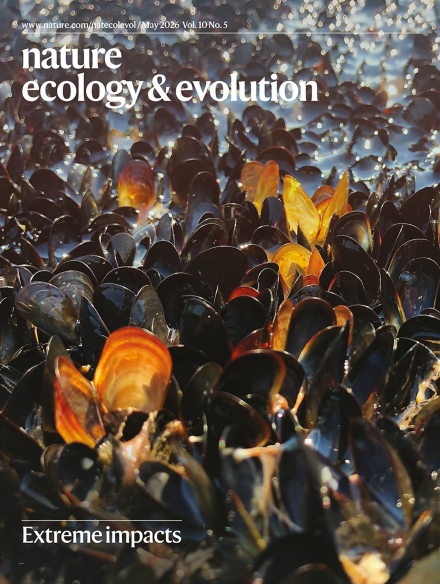
This Focus issue highlights research and opinion pieces on the variable impacts of extreme events on biodiversity, their short-term and long-term consequences, and conservation measures to mitigate their effects. The cover image depicts mass mortality of mussels in West Vancouver, British Columbia, Canada exposed to extreme heat at low tide during the 2021 western North American heatwave, commonly known as the ‘heat dome’.
In this Focus issue, we highlight the many and varied effects of extreme events on biodiversity, and how the increasing frequency of these events under climate change is threatening life on land and in water.
As climate change increases the frequency and severity of extreme events, targeted and proactive conservation measures must be implemented to protect endemic tropical island species from the extinction risk posed by cyclones.
As biodiversity net gain rises on the global agenda, Germany’s 50-year-old no-net-loss policy faces mounting resistance amid pressures to accelerate infrastructure development. We argue that the regulation remains essential for maintaining ecological integrity and that targeted reforms could make it more efficient, effective and transparent, and provide key lessons to inform global efforts.
A multi-trait analysis of a migratory songbird species shows that extreme winter storms have, beyond direct mortality, long-lasting effects on the phenology, genetics and demography of survivors.
An analysis of hundreds of fish biomass surveys shows that warmer years combined with marine heatwaves can enhance regional population abundances in the cold edges of species’ biogeographical distributions, but contribute to population declines at warmer latitudes.
A model of competition between unicellular and multicellular forms suggests that multicellularity can become ecologically stable without direct benefits, provided both forms use a varied environment in different ways.
The few plants that thrived after the Earth’s greatest mass extinction used a specialized physiology, known as crassulacean acid metabolism photosynthesis, that is adapted to extremely dry environments.
Analysis of marine fish populations reveals that nonlinear dynamics are widespread and that the degree of nonlinearity is elevated by high temperature variation and for species with fast life histories. These findings support the nonlinear amplification hypothesis and challenge assumptions of stable equilibrium dynamics commonly used in ecology studies and in fisheries management.
A 33-year study of 12 neighbouring capuchin groups reveals that group size asymmetries drive a population’s sociospatial structure. Larger groups offset heightened within-group competition by leveraging numerical superiority and monopolizing key resources at the expense of smaller groups. Yet this trade-off is context-dependent, and extreme climates compound ecological pressures on the largest groups.
There is growing evidence that extreme events linked to anthropogenic climate change can have important effects on biodiversity. Here the authors assess the exposure of terrestrial vertebrates to multiple types of extreme climate events globally.
Baum et al. present a synthesis of field data, remote-sensed data, media reports and process-based modelling analyses examining the effects of the 2021 heatwave in western North America for 32 terrestrial and marine taxa as well as gross primary productivity, streamflow and wildfire activity.
This study reported widespread declines in resilience after multi-year droughts and showed that biodiversity and climate strongly shape forest resilience after multi-year droughts, but human footprint makes biodiversity’s contribution consistently and strongly negative.
Climate change could make trees more vulnerable to natural enemies. Here the authors analyse forest damage caused by key pest species in North America in relation to climate, geography and biotic context, finding evidence that climate change tends to exacerbate pest damage.
Combining 27 years of citizen science data with whole-genome sequencing, the authors show that mass mortality of purple martins caused by a severe winter storm in the USA had demographic consequences for surviving populations, including delayed breeding and reproductive failures that are likely to persist for several years.
Long-term observational data from neighbouring white-faced capuchin groups combined with environmental data show that within- and between-group competition jointly shape space use, with their relative importance shifting with seasonal and interannual climate cycles.
A large-scale analysis of changes in fish biomass over 25 years identifies average biomass declines associated with long-term warming, as well as sharp decreases and increases in biomass associated with marine heatwaves at the warm and cold edges of species’ ranges, respectively.
A global analysis of marine fish populations involving 243 recruitment and 266 spawner time series across 143 species finds that nonlinear dynamics are widespread and that the degree of nonlinearity is amplified by temperature variation and in fast-lived species.
The spread of non-native species is likely to be compounded by further climate change and land-use intensification. Here the authors assess the potential distribution of 9,701 naturalized non-native plant species at a 10 × 10-km grid resolution and project shifts under two Shared Socioeconomic Pathways.
Aquatic insects such as mayflies, stoneflies and caddisflies are widely used for freshwater biomonitoring and could provide resource pulses to terrestrial insectivores. Here the authors show a positive relationship between the species richness of these insects and the prevalence of riparian birds across the conterminous USA.
This study reveals that some bacteria living in the phycosphere of marine diatoms and dinoflagellates are host-specific with genomic functions matching their hosts, while some termed as ‘foundation’ bacteria can span both phycosphere types.
This analysis of coral reef fish community structure reveals major differences in the energetic potential of planktivorous assemblages between Indo-Pacific and Caribbean coral reefs. Indo-Pacific reefs support greater planktivorous fish biomass and productivity, largely due to the contribution of species that feed on gelatinous plankton.
Morphological and stable isotope analysis of Early Triassic lycophyte leaves suggest they were similar to extant Isoetales and thus may have made use of crassulacean acid metabolism photosynthesis—a trait that may have been advantageous during the Permian–Triassic mass extinction.
A model for the evolution of multicellularity in a spatially heterogeneous environment shows that indirect mechanisms such as escape from competition and increased environmental exploitation can drive the evolution of multicellularity in the absence of direct benefits.