
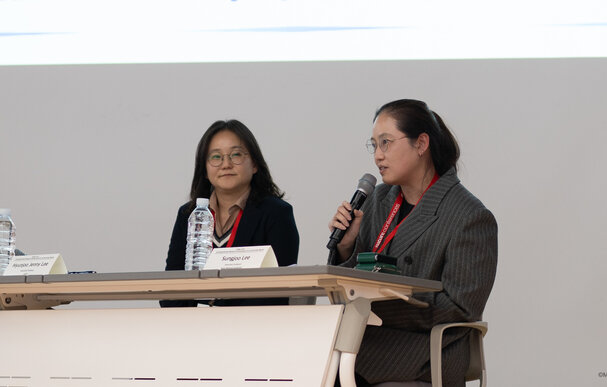
Sungjoo Lee (right) speaks during a panel discussion at Nature Index Live at KAIST in South Korea with Hyunjoo Jenny Lee (left), John Walsh and Moon Choi. Credit: SeongGwang Kim, Seung Hyun Kim, KAIST
Highlighting the contribution that outstanding researchers make to society and ensuring their salaries match those offered in medicine are two ways that countries can encourage more young people to pursue science careers, a recent Nature Index event has heard.
Some universities are struggling to fill courses in science, technology, engineering and maths (STEM) as young people seek the security and status of a medical career. “We’ve set it up so that medicine is attractive, but we’re making science and engineering especially unattractive,” John Walsh, a sociologist at Georgia Institute of Technology, in Atlanta, told the audience during a panel discussion at Nature Index Live, held at the Korea Advanced Institute of Science & Technology (KAIST), in Daejeon, South Korea.
The situation in South Korea is one example of this trend. In early 2024, the government announced an increase in the national medical school intake quota from around 3,058 places – a number that has remained fairly consistent since 2006 – to 5,058 from 2025. At the same time, graduate engineering schools are finding it difficult to attract talent, with some even struggling to recruit students from their own undergraduate courses, Nature Index reported last year.
Another panellist — Hyunjoo Jenny Lee, an electrical engineer who specializes in biomedical systems at KAIST — said she had seen researchers who would suit engineering ending up in medicine, and cited job security and pay as motivating factors.
“I work with a lot of medical doctors, and sometimes they are more ‘engineer-like’ than me. This says that these people with ‘engineering DNA’ are ending up in medical fields — we’re losing them,” Lee said. She added that engineers in South Korea created “a large portion” of the country’s economic value, but were not as well paid as doctors, especially compared to engineers in the United States.
“They’re not treated for their value and contributions to society, and if we did compensate them well, I’m sure the students would choose to come to STEM instead of medicine. They need to see that they do have a future if they go to graduate school — even if they don’t become a professor, there’s still a way to continue doing research.”
Walsh agreed, and said a major issue is the lack of clarity around what a career in science or engineering might look like in the coming years. He cited the fact that in many developed countries, professorships in these subjects are becoming more scarce, and called for different pathways for young researchers who might not want, or be able to get, such a role, but who still want to do impactful work.
Another issue is inefficiencies in labs, which are keeping young researchers from doing meaningful work, said Hyunjoo Jenny Lee. Lee talked about how in most South Korean universities, each lab establishes its own pipeline of operations and infrastructure, and a lot of the equipment set-up and maintenance work falls to early career researchers. Centralizing lab facilities and equipment within, and between, institutions, and hiring dedicated support staff to run them, would free up graduate students, she said. This would also create more stable career paths for research support staff, said Lee.
That said, it’s a lot easier for more recently established universities to do this than older institutions that have run independent labs for decades, Lee added. “It’s up to government policy and university leadership to decide how we are going to reform this current system into a centralized system.”
Sungjoo Lee, an industrial engineer at Seoul National University, said recognition for the work of scientists in society is key for attracting more young people back into STEM careers. She said that top researchers are paid well and express great personal satisfaction in their work, but “when we consider how much young researchers really know about these distinguished scientists, the awareness remains surprisingly limited”.
“We need to highlight living South Korean researchers and inventors to make STEM careers visionary,” Sungjoo Lee said. “By increasing the visibility of researchers through the mainstream media, award ceremonies and government initiatives, we can advance their social status to a level comparable to that of medical doctors.”
