Thank you for visiting nature.com. You are using a browser version with limited support for CSS. To obtain
the best experience, we recommend you use a more up to date browser (or turn off compatibility mode in
Internet Explorer). In the meantime, to ensure continued support, we are displaying the site without styles
and JavaScript.
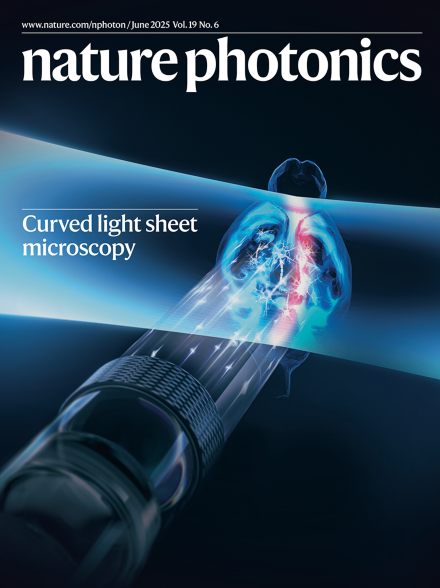
An artistic impression of curved light sheet microscopy of a mouse brain. The approach uses a curved light sheet as a source of illumination and a custom-designed objective lens to obtain image slices of cleared biological tissue that do not suffer from field curvature and provide diffraction-limited resolution over a wide field of view of 1 x 1cm2. The technique is applied to various mouse organs, enabling neuronal and vascular networks to be visualized.
Combining spatial and temporal modulation in aluminium zinc oxide metamaterials allows the fission of beams with distinct angles and frequencies, paving the way for advanced optical devices and applications like ultrafast beam steering and integrated neural networks.
A new method that uses light-induced superconducting quenches to generate abrupt, sub-picosecond, local magnetic field steps has potential applications ranging from spintronics to spectroscopy of quantum materials.
Key advances included subcycle laser development, quantum vortex visualization, and terahertz-based analysis of solar cells — showcasing the benefit of pulsed lasers across a wide range of disciplines.
Nonlinear optical properties of transparent conducting oxides are explored through the full spatio-spectral fission of an ultrafast 93-fs pulse traversing a submicrometre time-varying aluminium zinc oxide layer in its near-zero-index region, providing insights into the use of these materials for integrated photonics, photonic time crystals and integrated neural networks.
Three-dimensional multiplane structured illumination microscopy, combining three-beam interference, multiplane detection and a synergistically evolved reconstruction algorithm, enables 3D imaging at rates of up to 11 volumes per second in live cells with lateral and axial spatial resolutions of 120 and 300 nm, respectively.
Light sheet microscopy with curved light sheets enables tiling-free imaging of an entire intact cleared mouse brain with lateral and axial spatial resolutions of 1.0 μm and 2.5 μm, respectively, in less than 3 h.
Cross-polarized stimulated Brillouin scattering and its integration with quadratic nonlinearity is studied in lithium niobate, which enhanced photonic device performance in a reconfigurable stimulated Brillouin laser with 0.7-Hz narrow linewidth and 40-nm tunability, an efficient coherent mode converter, and Brillouin-quadratic laser and frequency comb operational in near-infrared and visible bands.
A convolutional network that approaches the fundamental Cramér–Rao bound is demonstrated to localize a reflective target hidden behind a dynamically fluctuating scattering medium, advancing algorithmic developments in the field of computational imaging.
Ultrafast magnetic field steps are generated by light-induced quenching of supercurrents in a YBa2Cu3O7 superconductor. They exhibit millitesla amplitude, picosecond rise times and slew rates approaching 1 GT s–1.
Exploiting the polariton-enhanced Purcell effect in tandem organic light-emitting diodes enables deep-blue-emitting devices with an external quantum efficiency of 36.8% and an LT90 lifetime of 830 h at an initial luminance of 500 cd m−2. These metrics are increased to 56% and 1,800 h with substrate light outcoupling.
Phonon polariton quasi-bound states in the continuum realized in a dielectric metasurface patterned with a subwavelength lattice of elliptical holes in a commercially available free-standing, large-area 100-nm-thick silicon carbide membrane is demonstrated, attractive for applications in mid-infrared optics, such as molecular sensing and thermal radiation engineering.
Using two-point optical frequency division based on a frequency-agile single-mode dispersive wave, a microwave signal source with record-low phase noise using a microcomb is demonstrated, offering over tenfold lower phase noise than state-of-the-art approaches.
A compact optical frequency division system with magnesium-fluoride-microresonator-based frequency references and silicon-nitride-microresonator-based comb generators is reported, offering a soliton pulse train at 25-GHz microwaves with an absolute phase noise of –141 dBc Hz–1 and timing noise below 546 zs Hz–1/2 at a 10-kHz offset frequency.
By leveraging microcavity-integrated photonics and Kerr-induced optical frequency division, an integrated photonic millimetre-wave oscillator with low phase noise is demonstrated, achieving –77 dBc Hz–1 and –121 dBc Hz–1, respectively, at 100-Hz and 10-kHz offset frequencies, corresponding to –98 dBc Hz–1 and –142 dBc Hz–1 when scaled to a 10-GHz carrier.
A laser design that exploits multiple bound states on a flat band to tightly confine light in three dimensions yields an ultracompact terahertz quantum cascade laser cavity with a lateral size of ~3λ.
An acceptor–donor–acceptor organic semiconductor enables near-infrared organic light-emitting diodes with reduced efficiency roll-off over six orders of magnitude of excitation current density, enabling a maximum luminance of 2,000 W sr−1 m−2.