
Abstract
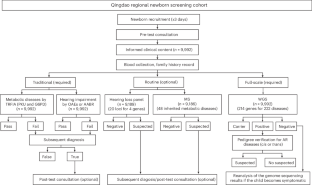
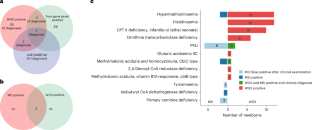
Genomic sequencing can identify nucleotide changes for underlying monogenic disorders, making it a promising newborn screening method for enabling early intervention and reducing false positives. Here, in this prospective study, we enrolled 9,992 newborns from the West Coast New District of Qingdao, China, within 3 days after birth; positive cases were followed until 31 March 2025 to assess the effectiveness of whole-genome sequencing (WGS) in neonatal screening. Among 9,992 newborns screened by WGS, 268 (2.7%) were positive. By the date of follow-up, 19 were clinically confirmed (11 hearing loss, 3 glucose-6-phosphate dehydrogenase deficiency, 2 Wilson disease, 2 phenylketonuria and 1 methylmalonic aciduria), of which 8 were missed by traditional screening. Among 19 symptomatic infants who underwent reanalysis, 8 (42.1%) were diagnosed with potentially pathogenic or pathogenic variants associated with the phenotype. Our findings indicate that integrating WGS into routine newborn screening could substantially improve early detection of monogenic diseases and enhance clinical outcomes in China.
This is a preview of subscription content, access via your institution
Access options
Subscribe to this journal
Receive 12 digital issues and online access to articles
$119.00 per year
only $9.92 per issue
Buy this article
- Purchase on SpringerLink
- Instant access to the full article PDF.
USD 39.95
Prices may be subject to local taxes which are calculated during checkout

Data availability
The data that support the finding of this study, including the allele frequency of the newborns at all the 95.86 million genetic variants, have been deposited in the Genome Variation Map 68 (https://ngdc.cncb.ac.cn/gvm/) at the National Genomics Data Center, China National Center for Bioinformation/Beijing Institute of Genomics, Chinese Academy of Sciences, under accession number GVM000685. The dataset is publicly accessible at http://bigd.big.ac.cn/gvm/getProjectDetail?project=GVM000685. The release of the data was approved by the Ministry of Science and Technology of China (project ID: 2024SQXB001172). To protect the genetic privacy of individual participants, the raw sequencing data and participant information are not publicly available. Sequencing data will be made available for collaborating researchers upon request, subject to approval by the Human Genetic Resources Administration of China (HGRAC). The approval process typically takes approximately 3–4 months from the date of submission to HGRAC. For data access requests, please contact the corresponding author S.P. (silinpan@126.com, Qingdao Women and Children’s Hospital).
Code availability
The code for the study is publicly available via GitHub at https://github.com/Dula2026/Analysis-pipline.
References
Therrell, B. L. et al. Current status of newborn screening worldwide: 2015. Semin. Perinatol. 39, 171–187 (2015).
van Spronsen, F. J. et al. Phenylketonuria. Nat. Rev. Dis. Primers 7, 36 (2021).
Chace, D. H., Kalas, T. A. & Naylor, E. W. The application of tandem mass spectrometry to neonatal screening for inherited disorders of intermediary metabolism. Annu. Rev. Genomics Hum. Genet. 3, 17–45 (2002).
Kwon, C. & Farrell, P. M. The magnitude and challenge of false-positive newborn screening test results. Arch. Pediatr. Adolesc. Med. 154, 714–718 (2000).
Adhikari, A. N. et al. The role of exome sequencing in newborn screening for inborn errors of metabolism. Nat. Med. 26, 1392–1397 (2020).
Chen, T. et al. Genomic sequencing as a first-tier screening test and outcomes of newborn screening. JAMA Netw. Open 6, e2331162 (2023).
Biesecker, L. G. & Green, R. C. Diagnostic clinical genome and exome sequencing. New Engl. J. Med. 370, 2418–2425 (2014).
Yang, R.-L. et al. A multicenter prospective study of next-generation sequencing-based newborn screening for monogenic genetic diseases in China. World J. Pediatr. 19, 663–673 (2023).
Zhou, Y. et al. Genetic identification of familial hypercholesterolemia within whole genome sequences in 6820 newborns. Clin. Genet. 105, 308–312 (2024).
Chien, Y.-H. & Hwu, W.-L. The modern face of newborn screening. Pediatr. Neonatol. 64, S22–S29 (2023).
Ziegler, A. et al. Expanded newborn screening using genome sequencing for early actionable conditions. JAMA 333, 232–240 (2025).
Ceyhan-Birsoy, O. et al. Interpretation of genomic sequencing results in healthy and ill newborns: results from the BabySeq project. Am. J. Hum. Genet. 104, 76–93 (2019).
Green, R. C. et al. Actionability of unanticipated monogenic disease risks in newborn genomic screening: findings from the BabySeq Project. Am. J. Hum. Genet. 110, 1034–1045 (2023).
Chen, Y. et al. Biallelic p.V37I variant in GJB2 is associated with increasing incidence of hearing loss with age. Genet. Med. 24, 915–923 (2022).
Yu, X. et al. Molecular epidemiology of Chinese Han deaf patients with bi-allelic and mono-allelic GJB2 mutations. Orphanet J. Rare Dis. 15, 29 (2020).
Chaker, L. et al. Hypothyroidism. Nat. Rev. Dis. Primers 8, 30 (2022).
White, P. C., Vitek, A., Dupont, B. & New, M. I. Characterization of frequent deletions causing steroid 21-hydroxylase deficiency. Proc. Natl Acad. Sci. USA 85, 4436–4440 (1988).
Jian, M. et al. A pilot study of assessing whole genome sequencing in newborn screening in unselected children in China. Clin. Transl. Med. 12, e843 (2022).
Wang, Q. et al. Nationwide population genetic screening improves outcomes of newborn screening for hearing loss in China. Genet. Med. 21, 2231–2238 (2019).
Andermann, A., Blancquaert, I., Beauchamp, S. & Déry, V. Revisiting Wilson and Jungner in the genomic age: a review of screening criteria over the past 40 years. Bull. World Health Org. 86, 317–319 (2008).
Hamosh, A. et al. Online Mendelian Inheritance in Man (OMIM), a knowledgebase of human genes and genetic disorders. Nucleic Acids Res. 30, 52–55 (2002).
Milko, L. V. et al. An age-based framework for evaluating genome-scale sequencing results in newborn screening. J. Pediatr. 209, 68–76 (2019).
Ceyhan-Birsoy, O. et al. A curated gene list for reporting results of newborn genomic sequencing. Genet. Med. 19, 809–818 (2017).
Drmanac, R. et al. Human genome sequencing using unchained base reads on self-assembling DNA nanoarrays. Science 327, 78–81 (2010).
Huang, J. et al. A reference human genome dataset of the BGISEQ-500 sequencer. GigaScience 6, 1–9 (2017).
Chen, Y. et al. SOAPnuke: a MapReduce acceleration-supported software for integrated quality control and preprocessing of high-throughput sequencing data. GigaScience 7, gix120 (2018).
Li, H. & Durbin, R. Fast and accurate short read alignment with Burrows–Wheeler transform. Bioinformatics 25, 1754–1760 (2009).
McKenna, A. et al. The Genome Analysis Toolkit: a MapReduce framework for analyzing next-generation DNA sequencing data. Genome Res. 20, 1297–1303 (2010).
Richards, S. et al. Standards and guidelines for the interpretation of sequence variants: a joint consensus recommendation of the American College of Medical Genetics and Genomics and the Association for Molecular Pathology. Genet. Med. 17, 405–423 (2015).
Lee, L. C., Liong, C.-Y. & Jemain, A. A. Partial least squares-discriminant analysis (PLS-DA) for classification of high-dimensional (HD) data: a review of contemporary practice strategies and knowledge gaps. Analyst 143, 3526–3539 (2018).
Wishart, D. S. et al. HMDB 5.0: the Human Metabolome Database for 2022. Nucleic Acids Res. 50, D622–D631 (2022).
Acknowledgements
We thank all the participants and clinicians for their involvement in this study. We thank the guidance and technical support of the China Baby Omics project.
Funding
This study was supported by the research grant from the subproject of the National Key R&D Program (grant no. 2023YFC2705600), National Natural Science Foundation of China (grant no. 82192864), the Shanghai Municipal Commission of Science and Technology Program (grant no. 23ZR1408000) and the Shanghai Municipal Commission of Health and Family Planning (grant no. 2024ZZ2017).
Author information
Authors and Affiliations
Contributions
Concept and design: S.P., L.Z., Y. Du, J.L. and X.J. Acquisition, analysis or interpretation of data: S.C., H.H., Y.C., P.D., X. Wang, J. Zhang, X.C., Q.F., J. Zhao, D.C., Y.S., Y.Z., J.S., R.C., L.Y., Y. Duan, L.L., M.F., G.Z., Y.H., N.L., Z.S., B.D., M.W., X. Wei, S.W., K.Y., D.L., D.M., L.C. and J.X. Drafting of the paper: P.D., Y.C. and S.C. Critical review of the paper for important intellectual content: H.H., J. Zhang, L.S., Z.P., Y.G., H.P., L.Z., Yutao D., J.L., X.J., C.X. and S.P. Statistical analysis: S.C., H.H., Y.C., P.D. and X. Wang. Administrative, technical or material support: S.P., L.Z., Y. Du, F.C., S.L., H.L., K.Y., D.L., D.M., L.C. and J.X. Supervision: H.H., Y.G., X.J., J.L., Y. Du, L.Z. and S.P.
Corresponding authors
Ethics declarations
Competing interests
The authors declare no competing interests.
Peer review
Peer review information
Nature Health thanks Richard Choy, Jun Liao and Kwong Wai for their contribution to the peer review of this work. Primary Handling Editor: Manonmani Soundararajan, in collaboration with the Nature Health team. Peer reviewer reports are available.
Additional information
Publisher’s note Springer Nature remains neutral with regard to jurisdictional claims in published maps and institutional affiliations.
Extended data
Extended Data Fig. 1 Statistical analysis of Qingdao newborn cohort.
(a) The average sequencing depth and coverage (1x, 10x, 20x). (b) The number of autosomal SNPs and INDELs identified.
Extended Data Fig. 2 Sanger traces for PCR products of the patient and his parents.
(a) Sanger sequencing chromatograms show that patient 1 carries the heterozygous c.323 T > C variant. The parents do not carry the variant. (b) Sanger sequencing chromatograms show that patient 2 carries the heterozygous c.573dupA variant. The parents do not carry the variant.
Extended Data Fig. 3 Metabolite analysis.
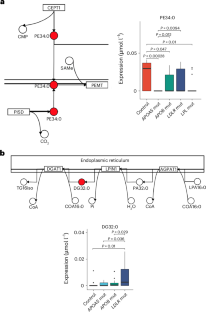
(a) PLS-DA of the amino acid metabolic disease-related mutations vs deafness-related mutations. (b) PLS-DA of dyslipidemia-related mutations vs deafness-related mutations. (c) Volcano plot showing differential metabolites between amino acid metabolic disease-related mutations and deafness-related mutations. (d) KEGG pathway enrichment analysis for amino acid metabolic disease-related mutations vs deafness-related mutations. (e) Volcano plot showing differential metabolites between dyslipidemia-related mutations and deafness-related mutations. (f) KEGG pathway enrichment analysis for dyslipidemia-related mutations vs deafness-related mutations.
Extended Data Fig. 4
Annotation process of WGS data during post- test consultation.
Supplementary information
Supplementary Tables 1–11 (download XLSX )
Supplementary Table 1: Comparison of the cost, turnaround time and gene contents between biochemical NBS and WGS. Supplementary Table 2: Positive results identified in suspected patients. Supplementary Table 3: Newborn numbers screened by WGS. Supplementary Table 4: Summary of 160 asymptomatic infants. Supplementary Table 5: Overview of abnormal newborns returned for post-hoc WGS consultation. Supplementary Table 6: A list of the 1,321 metabolites detected in this study. Supplementary Table 7: The 222 inherited diseases and 214 related genes screened by WGS. Supplementary Table 8: P/LP variants identified in the QDnewborn cohort. Supplementary Table 9: The 20 variants of 4 genes for hearing loss screened by MALDI-TOF-MS. Supplementary Table 10: The 48 inherited metabolic diseases screened by MS/MS. Supplementary Table 11: List of samples and diseases used for untargeted blood spot metabolomics.
Source data
Source Data Fig. 3 (download XLSX )
Statistical source data.
Source Data Fig. 4 (download XLSX )
Statistical source data.
Source Data Extended Data Fig. 2 (download XLSX )
Statistical source data.
Source Data Extended Data Fig. 4 (download XLSX )
Statistical source data.
Rights and permissions
Springer Nature or its licensor (e.g. a society or other partner) holds exclusive rights to this article under a publishing agreement with the author(s) or other rightsholder(s); author self-archiving of the accepted manuscript version of this article is solely governed by the terms of such publishing agreement and applicable law.
About this article

Cite this article
Chen, S., Huang, H., Chen, Y. et al. Clinical outcomes of a genomic newborn screening study in Qingdao, China. Nat. Health (2026). https://doi.org/10.1038/s44360-026-00147-5
Received:
Accepted:
Published:
Version of record:
DOI: https://doi.org/10.1038/s44360-026-00147-5

