Thank you for visiting nature.com. You are using a browser version with limited support for CSS. To obtain
the best experience, we recommend you use a more up to date browser (or turn off compatibility mode in
Internet Explorer). In the meantime, to ensure continued support, we are displaying the site without styles
and JavaScript.
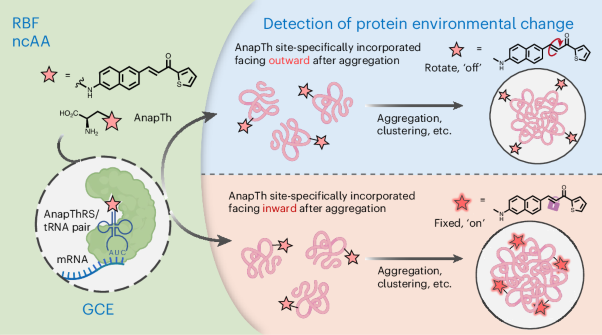
Microenvironmental changes in protein substructures are closely related to their functions and interactions. Yang, Jin, Zhang et al. report a method for real-time monitoring of these changes in target proteins in living cells through site-specific integration of AnapTh. AnapTh is an environment-sensitive noncanonical amino acid featuring a rotor-based fluorophore. The cover depicts the ‘off’ and ‘on’ states of AnapTh incorporated at specific sites within target proteins, enabling visualization of their interactions during aggregation and clustering.
Machine learning-based tools have revolutionized how scientists study protein structure. Here, Nature Chemical Biology speaks to Cecilia Clementi, Bruno Correia and Peilong Lu about progress in developing computational tools for predicting protein structure and properties, how these programs can be used for protein design, and the developments they would like to see in the field.
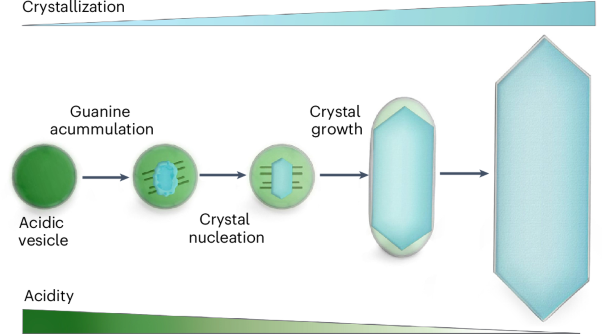
How biogenic crystals form within cells despite their building blocks being water insoluble is a conundrum. Now, it has been shown that zebrafish control the crystallization process by modulating organellar pH: first to accumulate guanine, and then to crystallize it.
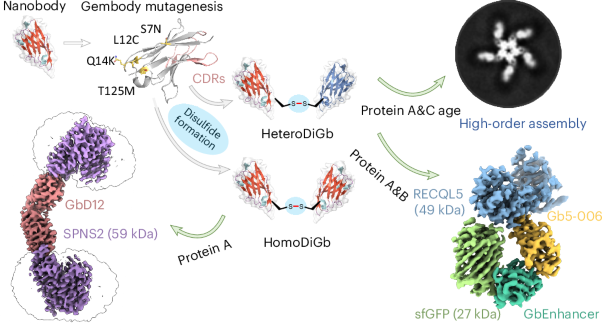
Small proteins are challenging targets for structure determination by cryo-electron microscopy. A new mass-enhancement strategy relies on rigid dimerization of a nanobody into a ‘di-gembody’ that increases protein mass by expanding the symmetry of small protein targets.
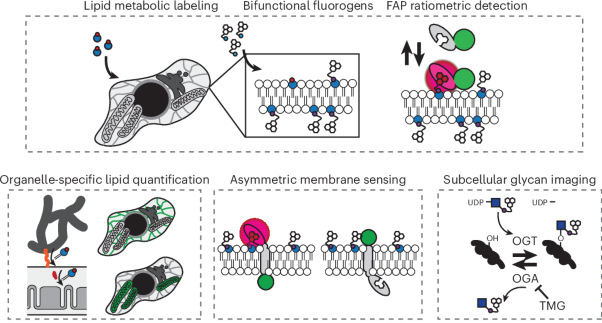
Approaches to study lipid composition with leaflet-specific resolution in living cells have been lacking. A new method — fluorogen-activating coincidence encounter sensing (FACES) — combines biorthogonal metabolic labeling with organelle-targeted fluorogen-activating proteins to selectively visualize lipids on leaflets of interest in any organelle.
A recent study developed a refined photocatalytic labeling-based method to capture and sequence physically interacting cells in situ and discovered how tumors induce pro-tumor neutrophils via cell contact.
mRNA has emerged as an important class of therapeutic molecules. Now, an artificial intelligence (AI)-driven framework, which can design mRNA sequences with enhanced stability and translational efficiency, has been reported. This method for designing mRNA sequences is known as ‘generative models for RNA’ (GEMORNA) and could help to design more effective mRNA-based treatments.
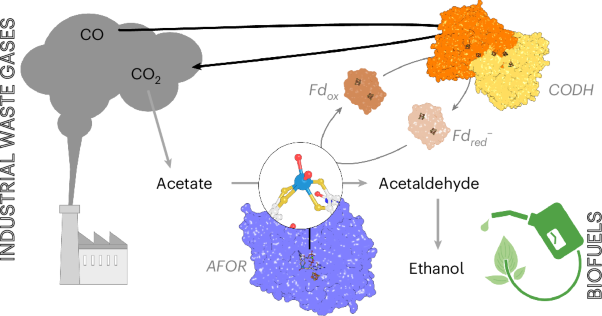
Clostridium autoethanogenum produces ethanol from waste gases, but the biosynthetic pathway has been debated. Now, a combination of structural and biochemical data confirms that a key step in the ethanol biosynthesis pathway is acetate reduction by a tungsten-dependent aldehyde:ferredoxin oxido-reductase. This thermodynamically unfavorable reaction is counterbalanced by the coupling of ethanol synthesis with CO oxidation.
Many animals display brilliant colors thanks to the precise formation of guanine crystals within specialized organelles. Here, the authors demonstrate that dynamic pH shifts orchestrate this process: an initially acidic lumen stabilizes amorphous, protonated guanine and subsequent alkalinization triggers its crystallization.
Microbial alcohol production from waste gases could enable sustainable carbon cycling. Now, the tungsten-dependent aldehyde:ferredoxin oxidoreductase from the gas-converting bacterium Clostridiumautoethanogenum has been biochemically and structurally characterized. This monomeric enzyme is responsible for acetate reduction to acetaldehyde, the key step of ethanol production in this industrial microorganism.
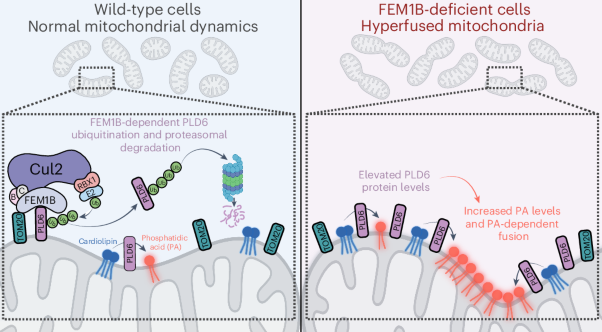
Raiff, Zhao and colleagues identified the E3 ligase CRL2FEM1B as a regulator of mitochondrial fusion. CRL2FEM1B is recruited to mitochondria by TOM20, where it promotes PLD6 ubiquitination and degradation to maintain mitochondrial health.
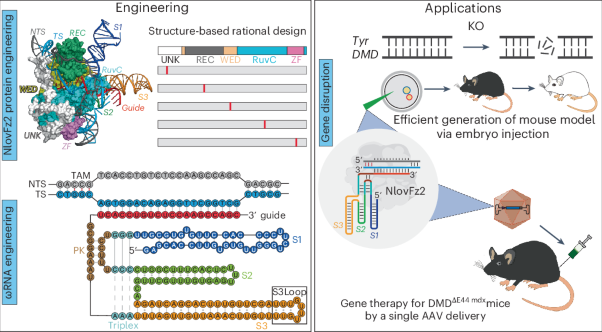
By engineering the eukaryotic-derived Fanzor2-ωRNA system, Wei, Gao, Pan, Li and Chen developed a compact genome editor enNlovFz2, which demonstrated efficient genome-editing activity in vitro and in vivo, with a broad target-adjacent motif scope.
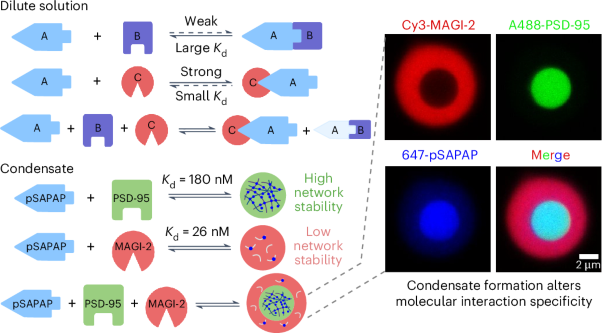
Using two synaptic proteins as examples, Chen et al. reveal that phase-separation-mediated formation of molecular condensates can change the biomolecular interaction specificities; the network complexity in the condensates can have a stronger impact than affinity on the subcellular localization of proteins.
Disulfide-based dimerization of modified identical and heterologous nanobody scaffolds enables higher-order assembly for high-resolution cryo-electron microscopy structure determination that is widely applicable to small protein targets.
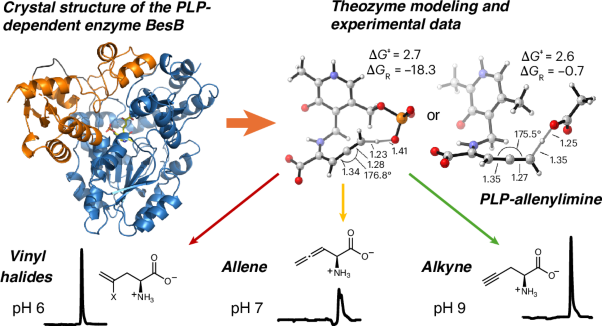
Alkynes found in natural products are typically assembled by metal-dependent enzymes. The enzyme BesB instead forms a terminal alkyne-containing amino acid using pyridoxal phosphate as a cofactor. Here, the authors use structural and mechanistic investigations to identify the key features of BesB that allow it to carry out its fascinating chemistry.
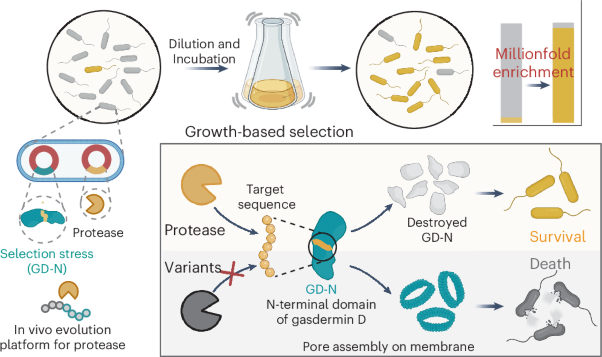
An in vivo selection system based on the toxicity regulation of the N-terminal domain of gasdermin D and evolution of tobacco etch virus protease (TEVp) has been developed. The method enables development of a TEVp capable of precise cleavage of specific sequences on target proteins.
The use of bulky protein tags and the limited positions available for probe introduction restrict current methods for studying protein microenvironments at high spatial resolution. Here the authors genetically incorporate small environment-sensitive fluorescent amino acids to visualize real-time microenvironmental changes at specific protein substructures.
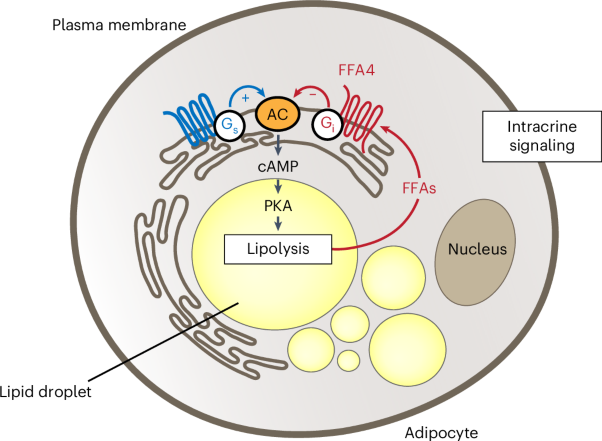
An ‘intracrine’ signaling mechanism is proposed whereby a G-protein-coupled receptor (free fatty acid receptor 4) senses locally released fatty acids on intracellular membranes associated with lipid droplets to efficiently regulate lipolysis in adipocytes.
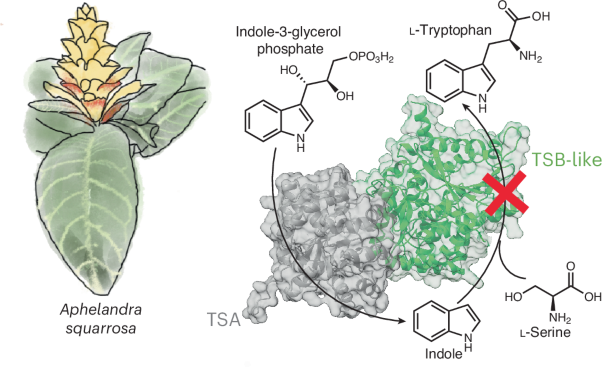
Despite the importance of indole in plant defense and communication, its biosynthesis in core eudicots remains elusive. Here the authors report the identification of TSB-like, a pseudoenzyme that hijacks an enzyme of tryptophan biosynthesis to produce indole.
An approach combining bioorthogonal chemistry with genetically encoded fluorogen-activating proteins enables subcellular imaging of phospholipids and glycans, as well as the visualization of lipid transport between organelles and lipid asymmetry across membrane leaflets.
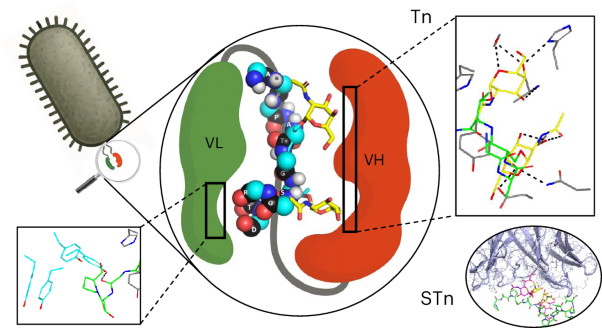
Structural studies of certain Tn and STn antigen-targeting antibodies reveal that their VH and VL domains recognize the glycan antigen and the adjacent peptide region, respectively, enabling a VH domain-focused and VL domain-varying phage display library to generate antibodies targeting diverse glycopeptide epitopes.
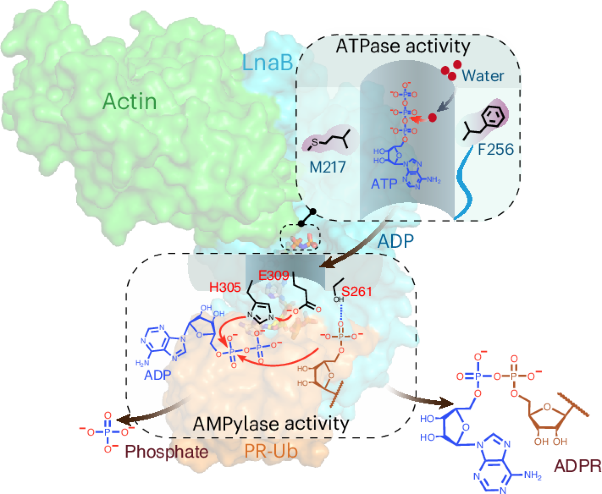
Legionella effector LnaB, a recently identified actin-activated AMPylase, mediates phosphoryl-AMPylation in a yet-unknown manner. Here the authors unveil a two-step catalytic process involving dual ATPase–AMPylase activity based on structural studies, providing a biochemical basis for AMPylation.