
Thank you for visiting nature.com. You are using a browser version with limited support for CSS. To obtain
the best experience, we recommend you use a more up to date browser (or turn off compatibility mode in
Internet Explorer). In the meantime, to ensure continued support, we are displaying the site without styles
and JavaScript.
An artistic impression of an organic semiconductor emitter of white polarized light (top image) that makes use of a blue-emitting host and red- and green-emitting guest molecules (middle image). The approach allows for the realization of polarized white LEDs and light-emitting transistors, which could prove to be useful for displays and other applications in optoelectronics (bottom image).
Image: Zhengsheng Qin and Huanli Dong from the Institute of Chemistry, Chinese Academy of Sciences, and Wenping Hu from Tianjin University. Cover design: Bethany Vukomanovic
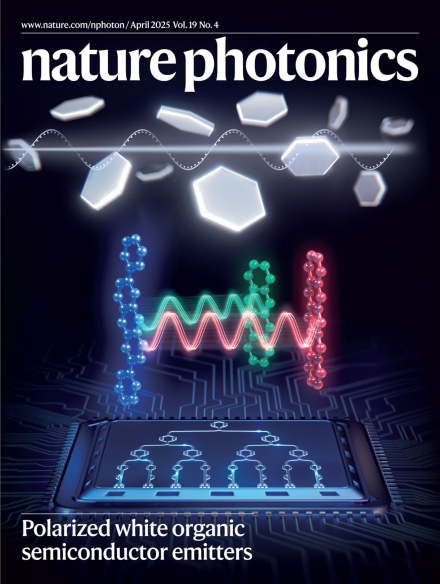
Intrinsically polarized white-light emission is highly demanded for many applications. It is now possible to realize it via a bimolecular doping strategy of organic semiconductor single crystals, overcoming long-standing limitations in organic emitters.
An angular Fourier optics framework has been established and demonstrated, unlocking unprecedented opportunities for the analysis and manipulation of light waves carrying orbital angular momentum.
Two-dimensional materials have revolutionized the field of photonics by enabling the manipulation of light at the nanoscale. As their potential continues to grow, we can expect to see more innovative applications emerging in the future.
Photoelectron quantum-state tomography is demonstrated in helium and argon atoms upon the absorption of ultrashort, extreme ultraviolet light pulses. The purity and degree of entanglement of a mixed photoelectron and ion state are quantified following coherent two-photon ionization using an extreme ultraviolet pulse and two infrared pulses.
Hybrid hetero-integration of dual-functional perovskite diodes and a photonic neural network for computing tasks are demonstrated on a near-infrared monolithic on-chip photonic system based on a perovskite/silicon nitride platform, exemplifying the extension of perovskite device applications.
Simultaneous measurements of the optical force and power exerted by a collimated laser beam on a 50-nm-thick silicon nitride lightsail membrane suspended by compliant micromechanical springs quantify the radiation pressure, enabling further multiphysics studies of radiation pressure forces on macroscopic objects.
A bimolecular doping strategy enables the realisation of white organic polarized emissive semiconductor single crystals, emitting white light with a maximum degree of polarization as high as 0.96. Organic polarized light-emitting diodes and light-emitting transistors with tuneable emission wavelength are also demonstrated.
By resonant excitation of an InAs quantum dot embedded in a microcavity, a deterministic single-photon source is demonstrated. Single-photon purity of 0.9795(6), photon indistinguishability of 0.9856(13), and an overall end-to-end efficiency of 0.712(18) are simultaneously obtained.
The generalized self-imaging, or generalized Talbot, effect is demonstrated in the azimuthal angle and orbital angular momentum (OAM) domains, providing both a universal strategy for fully arbitrary control of the angular petal numbers or OAM mode spacing and a general method for the realization of efficient OAM mode sorters.
By pairing an octave-spanning terahertz microcomb with a terahertz Vernier microcomb, a continuous-wave laser at 871 nm is frequency divided to a radiofrequency clock output at 235 MHz. This laser is designed for frequency doubling to reach the ytterbium ion clock transition at 435.5 nm.
A superconducting nanowire two-photon coincidence counter is demonstrated with topological optimization of delay-time series. Using a hybrid time–amplitude multiplexing strategy, all 152 potential single- and two-photon events are resolved in a 16-pixel configuration.
A systematic study of 15 non-fullerene-based organic solar cells elucidates loss mechanisms and enables an encapsulated device to retain 91% of its initial efficiency after seven months of outdoor operation in Saudi Arabian climate.
By engineering the crystallization process of Sn–Pb mixed perovskite films, all-perovskite tandem solar cells fabricated using an antisolvent-free method deliver a certified power conversion efficiency of 28.87% and retain 87% of this efficiency after 450 h of operation.
Guiding light around dynamic regions of a scattering object by means of propagating light through the most ‘stable’ channel within a moving scattering medium is demonstrated, potentially advancing fields such as deep imaging in living biological tissue and optical communications through turbulent air and underwater.