
Thank you for visiting nature.com. You are using a browser version with limited support for CSS. To obtain the best experience, we recommend you use a more up to date browser (or turn off compatibility mode in Internet Explorer). In the meantime, to ensure continued support, we are displaying the site without styles and JavaScript.

Volume 19 Issue 5, May 2025

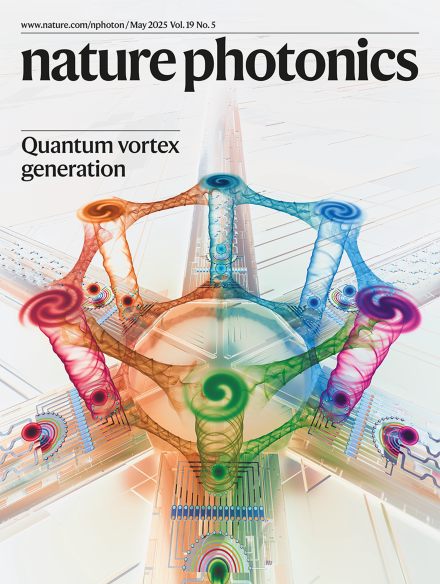
Quantum vortex generation

An artistic illustration of an integrated nanophotonic circuit for generating entangled quantum vortices. The programmable capabilities of the on-chip emitter enable reconfiguration within microseconds and open avenues for applications in quantum communication, quantum light detection and ranging, and quantum computation and storage.

See Huang et al

Image: Jieshan Huang and Jianwei Wang, Peking University. Cover design: Bethany Vukomanovic
News & Views

  • Topological localization of photons in both space and time has now been experimentally realized through synthetic photonic quantum walks, enabled by non-Hermitian gain–loss modulations. This investigation into time and space-time topology reveals unique phenomena beyond conventional spatial topological effects, including causality-suppressed coupling.

    • Zhe Zhang
    • Romain Fleury
    News & Views

    Advertisement

  • Local measurements of biological voltage production are key drivers of understanding in neurobiology and neurological and cardiac pathophysiology. Researchers have now shown that exciton–trion conversion in a two-dimensional semiconductor, MoS2, can be used to optically image cardiomyocyte action-potentials in real-time.

    • Daniel J. McCloskey
    News & Views
  • A programmable quantum chip has been developed that generates, manipulates, and launches five-dimensional entangled photons into free-space channels, encoded as optical vortex modes, thus bridging the worlds of integrated and free-space quantum photonics.

    • Filippo Cardano
    • Lorenzo Marrucci
    News & Views
Top of page ⤴

Review Articles

  • This Review summarizes the recent progress in ultrahigh-bandwidth optical-fibre communications based on integrated optical frequency comb technologies, or integrated Kerr microcombs, highlighting the challenges and opportunities ahead.

    • Bill Corcoran
    • Arnan Mitchell
    • David J. Moss
    Review Article
Top of page ⤴

Articles

  • By integrating a moiré photonic structure on-chip with advanced microelectromechanical system (MEMS) technology, an in situ twisted moiré photonic platform that can be tuned is realized, enabling nanometre-scale positioning of two optical nanostructures in either the near- or far-field coupling regime.

    • Haoning Tang
    • Beicheng Lou
    • Eric Mazur

    Collection:

    Article
  • Combining on-chip photon-pair sources, two sets of linear integrated circuits for path entanglements and two path-to-orbital angular momentum converters, free-space-entangled orbital angular momentum photon pairs can be generated in high-dimensional vortex states, offering a high level of programmable dynamical reconfigurability.

    • Jieshan Huang
    • Jun Mao
    • Jianwei Wang
    Article
  • The partial replacement of the A-site by divalent methylenediammonium cations inhibits ion migration and photoinduced halide segregation in wide-bandgap perovskites. Single-junction devices achieve a certified power conversion efficiency of 22.71%, whereas perovskite/Cu(In,Ga)Se2 tandem devices exhibit an efficiency of 30.13% in a four-terminal architecture.

    • Liuwen Tian
    • Enbing Bi
    • Rui Wang
    Article
  • A miniaturized diffractive neural network is fabricated on the distal facet of a multimode fibre, allowing all-optical image transportation through the fibre. With a compact footprint of 150 μm × 150 μm, the system allows the transportation of images with a minimum feature size of 4.90 μm and shows transfer learning capabilities when transporting images of biological cells projected by spatial light modulators.

    • Haoyi Yu
    • Zihao Huang
    • Qiming Zhang
    Article
  • Using a grating-based mode-splitting and reflector approach, a bidirectional chip-scale nanophotonic Kerr-resonator circuit that consumes 97% of the pump power to generate a soliton frequency comb at approaching unit efficiency with 65% conversion efficiency is reported.

    • Jizhao Zang
    • Su-Peng Yu
    • Scott B. Papp
    Article
  • Combining space topology and time topology, topological states that are localized simultaneously in space and time are theoretically and experimentally demonstrated, potentially enabling the space-time topological shaping of light waves with applications in spatiotemporal wave control for imaging, communications and topological lasers.

    • Joshua Feis
    • Sebastian Weidemann
    • Alexander Szameit
    Article Open Access
  • Cluster states with three-dimensional connectivities are realized by selecting specific time–frequency mode bases for multimode quantum light. The cluster state generation is verified by nullifier measurements as well as full inseparability tests across all possible bipartitions.

    • Chan Roh
    • Geunhee Gwak
    • Young-Sik Ra
    Article
  • Researchers demonstrated integrated non-magnetic isolators with 24.5-dB contrast, –2.16-dB insertion loss and 2-THz (16-nm) optical bandwidth.

    • Haotian Cheng
    • Yishu Zhou
    • Peter T. Rakich
    Article
  • The researchers exploit exciton-to-trion conversion in ångström-thick semiconductors for all-optical detection of electrical activity in cardiomyocyte cultures. This approach affords high temporal resolution and paves the way for elusive label-free all-optical voltage-sensing applications of two-dimensional semiconductor materials in the biological domain.

    • Yundong Ren
    • Chawina De-Eknamkul
    • Ertugrul Cubukcu
    Article
Top of page ⤴

Amendments & Corrections

Top of page ⤴

Search

Quick links