Thank you for visiting nature.com. You are using a browser version with limited support for CSS. To obtain
the best experience, we recommend you use a more up to date browser (or turn off compatibility mode in
Internet Explorer). In the meantime, to ensure continued support, we are displaying the site without styles
and JavaScript.
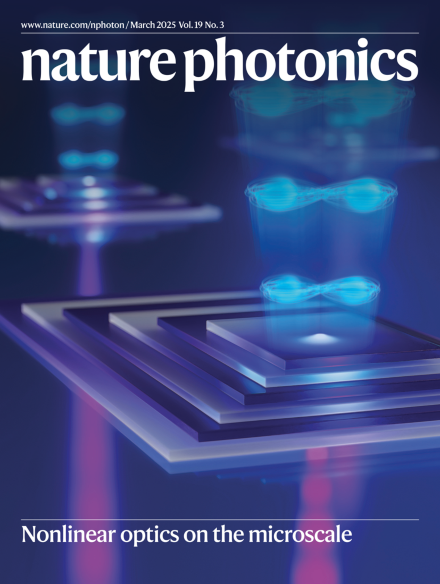
Thin stacks of periodically poled transition dichalcogenide crystals provide exceptionally large nonlinear optical responses, enabling the efficient generation of entangled photons from microscale structures.
The performance of super-resolution microscopy is continuously improving. Nature Photonics interviewed Stefan Hell, from the Max Planck Institute for Multidisciplinary Sciences, about key milestones in the field, current capabilities of MINFLUX and what remains to be excited about.
Super-resolution microscopy offers valuable tools to tackle biological questions. Nature Photonics spoke with Markus Sauer, from the University of Würzburg, about the advantages and outstanding challenges of super-resolution microscopy for biological applications.
The challenges of fabricating low-loss waveguides and the reliance on bulky external magnets hinder the miniaturization of Faraday isolators. Now, researchers have overcome this limitation by femtosecond laser writing of waveguides within latched garnet.
By combining an ultralow-loss silicon nitride reference cavity with a diode laser, the interrogation of a strontium-ion optical clock is possible with excellent accuracy. The development is a step towards miniature, integrated optical clocks.
The authors present a review of super-resolution optical fluctuation imaging (SOFI), including its core working principle, recent advances and remaining challenges.
The authors review MINFLUX super-resolution microscopy, outlining its advantages and limitations, recent progress, and an outlook for future developments.
Using a new femtosecond laser writing technique, researchers inscribed waveguides within latched bismuth-doped iron garnet, enabling a Faraday rotator waveguide exhibiting <0.15 dB insertion loss and a figure of merit of 346° dB−1. This enabled a miniaturized optical isolator waveguide with >25 dB isolation ratio and <1.5 dB insertion loss over the entire optical telecom C-band, without lenses or an external magnet.
The use of a hydrogen-bonded eutectic molecule as a ligand stabilizes black phase perovskite, resulting in solar cells with a T95 lifetime of 2,000 h and an efficiency of 25.8%.
An on-chip, high-bandwidth-density non-Hermitian hybrid switching network based on the integration of III–V and silicon materials is demonstrated, paving the way for compact and ultrafast monolithic integrated silicon photonics for large-scale and high-dimensional information processing.
Optical Einstein–Podolsky–Rosen correlation is observed on a picosecond timescale in a continuous-wave system. By introducing waveguide optical parametric amplifiers and balanced detectors, the quantum correlation 4.5 dB below the shot-noise level is observed.
A chip-integrated laser with 7.5 × 10⁻¹⁴ fractional frequency instability is demonstrated by active stabilization to an on-chip 6.1-m-long spiral resonator. By using this laser to interrogate the narrow-linewidth transition of 88Sr+, a clock instability averaging down as \(3.9\times 1{0}^{-14}/\sqrt{\tau }\) is achieved.
By considering waves from a bounding spherical volume, a clear onset of a tunnelling escape of waves that both defines a limiting number of well-coupled channels for any volume and explains the subsequent rapid fall-off of coupling strengths can be obtained.
Researchers created a periodically poled van der Waals semiconductor (3R-MoS2) and achieved a macroscopic frequency conversion efficiency of 0.03% over a thickness of 3.4 μm. The quasi-phase-matched second harmonic signal surpasses the usual quadratic enhancement by 50% and broadband generation of photon pairs at telecom wavelength is demonstrated with a coincidence-to-accidental ratio of 638 ± 75.
The feasibility of using second-harmonic generation to measure the broken time-reversal symmetry and valley polarization in monolayer WSe2 is presented, simplifying the process of probing valleys on ultrafast timescales without perturbing the system.
A CMOS-compatible watt-class power amplifier based on large-mode waveguide technology is realized with an on-chip output power reaching ~1 W within a footprint of ~4 mm2, enabling integrated photonics to tackle true systems level integration.
An ultrastrong exciton–polariton coupling in two-dimensional excitonic mithrene with a large refractive index and a large oscillator strength of its primary exciton is reported, enabling the formation of self-hybridized exciton–polaritons with Rabi splitting of >600 meV.
Lower bounds on the energy-constrained and unconstrained two-way quantum and secret-key capacities of all phase-insensitive bosonic Gaussian channels are provided. It proves that a non-zero capacity exists for all parameters where the phase-insensitive bosonic Gaussian channels are not entanglement breaking.