Thank you for visiting nature.com. You are using a browser version with limited support for CSS. To obtain the best experience, we recommend you use a more up to date browser (or turn off compatibility mode in Internet Explorer). In the meantime, to ensure continued support, we are displaying the site without styles and JavaScript.

Volume 5 Issue 2, February 2026

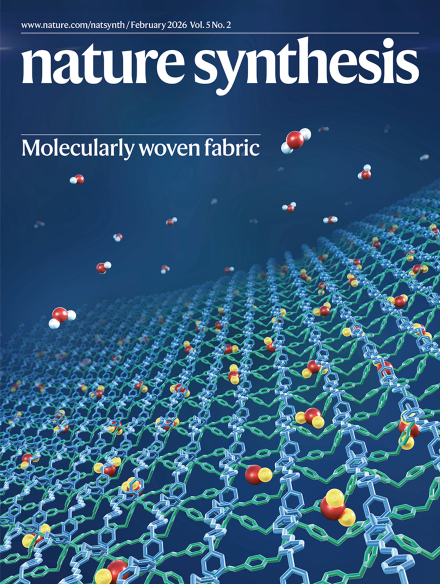
Molecularly woven fabric

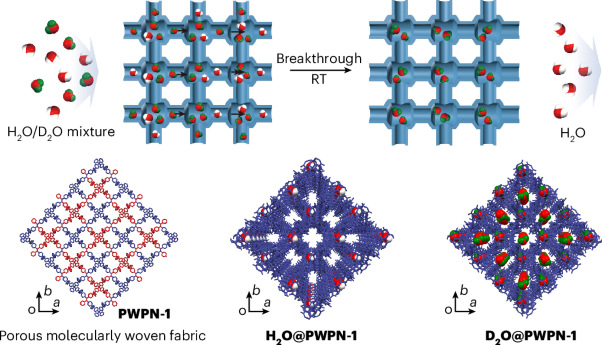
A porous molecular fabric is constructed by stacking two-dimensional woven layers to create a three-dimensional porous structure. This material enables efficient and dynamic separation of isotopologues H2O and D2O.

See Xiao et al.

Image: Ding Xiao, Zhejiang University. Cover design: Thomas Phillips
Research Highlights

Top of page ⤴

News & Views

Top of page ⤴

Research Briefings

  • The synthesis of covalent organic frameworks — a class of crystalline porous polymer — has been limited to reversible polycondensation reactions, whereas irreversible coupling reactions have typically yielded amorphous materials. Now, a micro-interfacial polymerization method is developed that uses the Glaser–Eglinton coupling reaction to synthesize covalent organic frameworks.

    Research Briefing
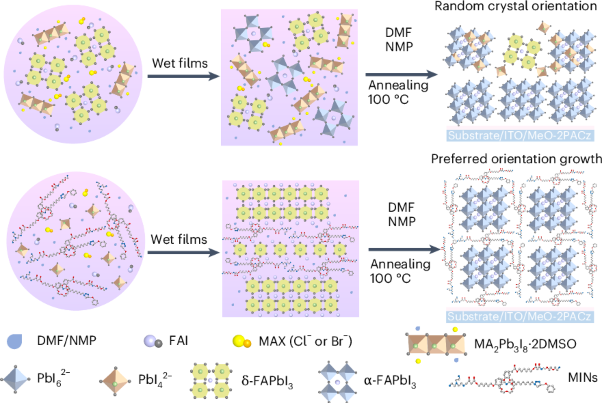
  • The scalable fabrication of perovskite solar cells is hindered by the uneven deposition of perovskite colloidal particles during printing. Now, introduction of a mechanically interlocked network into the precursor ink to construct a three-dimensional network immobilizes the particles, regulating their rheological behaviour and enabling uniform deposition of large-area films.

    Research Briefing
Top of page ⤴

Reviews

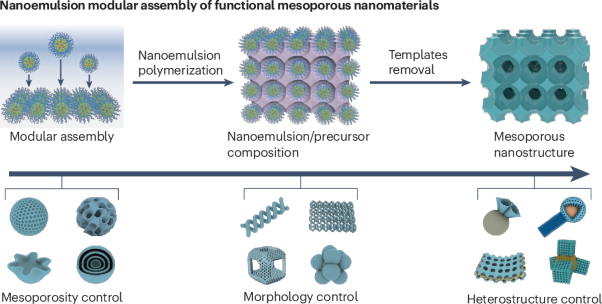
  • Nanoemulsion modular assembly is emerging as a versatile strategy for synthesizing diverse functional mesoporous nanomaterials. This Review highlights the capabilities of nanoemulsion modular assembly for precise control over pore size, structure, composition and morphology, as well as discussing possible applications of functional mesoporous nanomaterials.

    • Liang Peng
    • Huarong Peng
    • Zuankai Wang
    Review Article
Top of page ⤴

Research

  • The low natural abundance of heavy water makes high-purity extraction challenging. Here, a porous molecularly woven fabric is constructed that features adaptive pores enabling the efficient dynamic separation of water isotopologues at room temperature (298 K).

    • Ding Xiao
    • Dingyue Hu
    • Feihe Huang
    Article Open Access
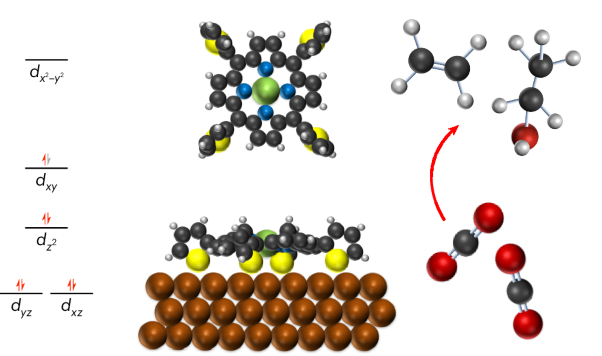
  • Model thiophene-decorated nickel porphyrins are synthesized to examine how sulfur promotes CO2-to-CO conversion and tandem CO2-to-C2 product conversion in electrocatalytic CO2 reduction. Combined theoretical and experimental analyses show that thiophene substituents generate a ligand hole character that modulates the nickel-centred electronic structure, enhancing overall catalytic performance.

    • Yi-Hsuan Lu
    • Yu-Jhih Shen
    • Sung-Fu Hung
    Article
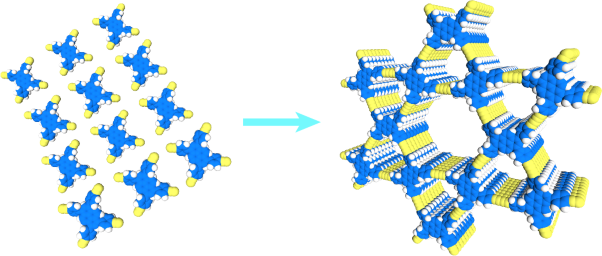
  • A microinterfacial solvothermal polymerization strategy is developed for irreversible coupling reactions to form porous crystalline sp-carbon-conjugated covalent organic frameworks with diverse topologies. These two-dimensional frameworks exhibit enhanced conductivity and tunable magnetic properties.

    • Zhuoer Li
    • Shanshan Tao
    • Donglin Jiang
    Article
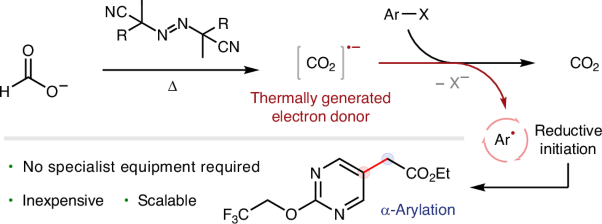
  • Radical chain initiation strategies are fundamental to the synthesis of small molecule drugs and macromolecular materials. Here a general, thermally driven and scalable method for reductive initiation is reported, in which inexpensive azo initiators are reacted with formate salts to form a carbon dioxide radical anion.

    • Ethan R. X. Lim
    • Bradley D. Cooper
    • Michael J. James
    Article Open Access
  • A [2]catenane comprising two intertwined aromatic (34π) octaphyrinoid rings with entangled magnetic shielding interactions is synthesized. Upon four-electron oxidation, the system converts to a tetracation with two globally antiaromatic (32π) rings, in which through-space bonding interactions diminish the antiaromatic destabilization. Counterions can also affect the (anti)aromaticity of the tetracations.

    • Yuguang Sui
    • Zipeng Wang
    • Yong Ni
    Article
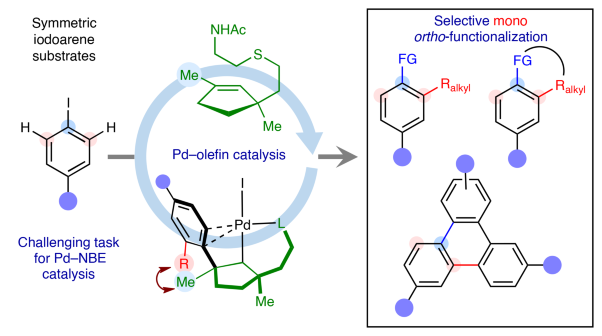
  • Palladium–olefin catalysis is utilized to overcome the ‘ortho constraint’ in the Catellani reaction of para-substituted iodoarenes. Using a methyl-modified thio-cycloolefin ligand, this method enables selective mono-alkylative vicinal difunctionalization of para-substituted iodoarenes, which is unattainable by conventional palladium–norbornene catalysis.

    • Yu-Xiu Li
    • Cheng-Hao Zong
    • Lei Jiao
    Article
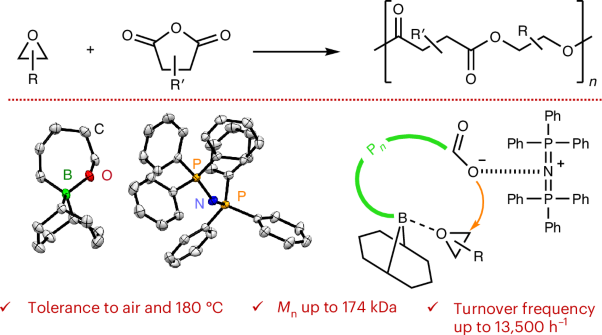
  • Covalently tethered borane–oxyanion organocatalysts enable highly efficient ring-opening copolymerization of epoxides and cyclic anhydrides via intramolecular cooperation, achieving turnover frequencies up to 13,500 h−1 and high molecular weights up to 174.0 kDa. These catalysts feature air stability, broad substrate scope, thermal stability and metal-free polyester production.

    • Ximin Feng
    • Xiong Liu
    • Xinghong Zhang
    Article
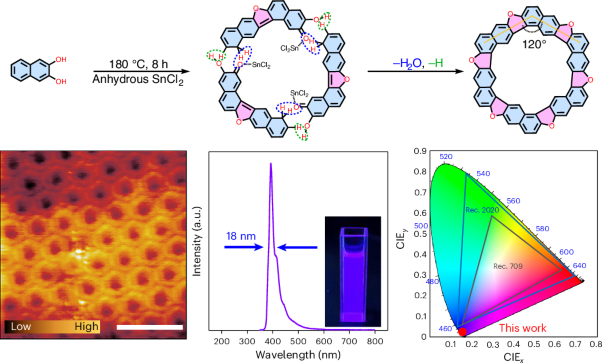
  • Planar oxygen-doped carbon quantum rings (OD-CQRs) are prepared through one-pot solid-state reactions. The synthesized OD-CQRs exhibit a fluorescence peak centre at 393 nm, a full-width at half-maximum of 18 nm and a photoluminescence quantum yield of 95%. Electroluminescent light emitting diodes based on OD-CQRs demonstrate high-colour-purity violet emission.

    • Xianzhi Song
    • Chen Zhang
    • Louzhen Fan
    Article
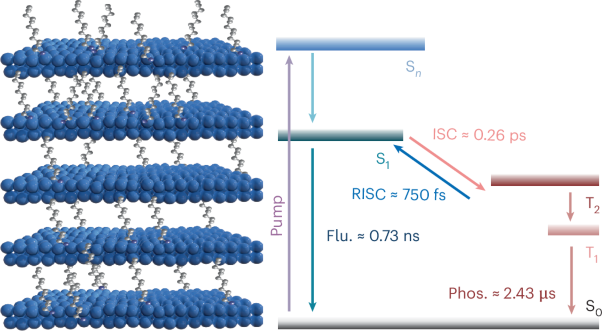
  • Gold-based layered hybrid superlattices with tunable interlayer spacing are synthesized as an efficient strategy to modulate intersystem crossing (ISC). Reduced interlayer spacing enhances Au–π conjugation, accelerating the ISC to 0.26 ps and enabling tailored spin–orbit interactions for advanced optoelectronic applications.

    • Haosen Yang
    • Yutong Zhang
    • Lin Guo
    Article
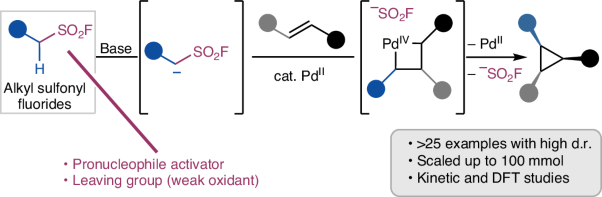
  • The ambiphilic reactivity of alkyl sulfonyl fluorides in stereoselective cyclopropanation under Pd(II) catalysis is reported. The method provides convenient access to cis-disubstituted cyclopropanes that are otherwise challenging to access. A representative carboxylic acid cyclopropane building block is scaled up to 100 mmol, demonstrating the practicality of this transformation.

    • Yilin Cao
    • Warabhorn Rodphon
    • Keary M. Engle
    Article Open Access
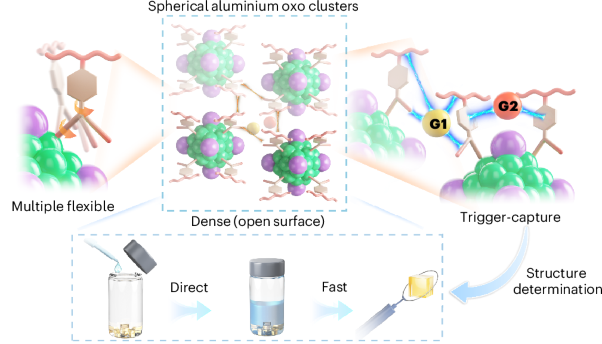
  • Nanoclusters have precise structures and therefore offer a molecular-level approach for studying surface adsorption phenomena. Here, spherical aluminium oxo clusters are synthesized via a co-encapsulation strategy to examine the inclusion of various guest molecules. This model paves the way for rapid recognition of organic molecules by nanoparticle surfaces.

    • Si-Hao Shen
    • Jian Hao
    • Jian Zhang
    Article
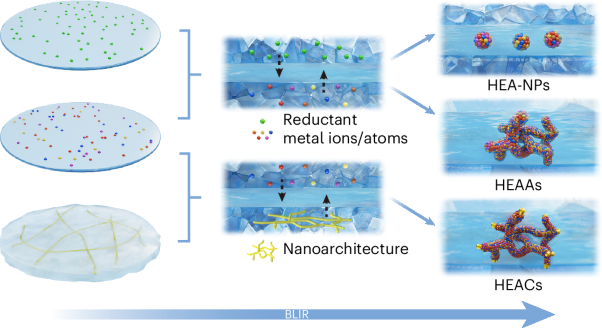
  • High-entropy alloy (HEA) nanoparticles, self-supporting HEA aerogels and HEA coatings with up to 11 metal elements and uniform elemental distributions have been synthesized at subzero temperatures using a bilayer ice recrystallization method. The process is observed by cryo-transmission electron microscopy and fused multimodal electron tomography.

    • Kaiqi Li
    • Xiaoyue Sun
    • Zhiyuan He
    Article
Top of page ⤴

Search

Quick links