
Thank you for visiting nature.com. You are using a browser version with limited support for CSS. To obtain the best experience, we recommend you use a more up to date browser (or turn off compatibility mode in Internet Explorer). In the meantime, to ensure continued support, we are displaying the site without styles and JavaScript.

Volume 6 Issue 1, January 2026

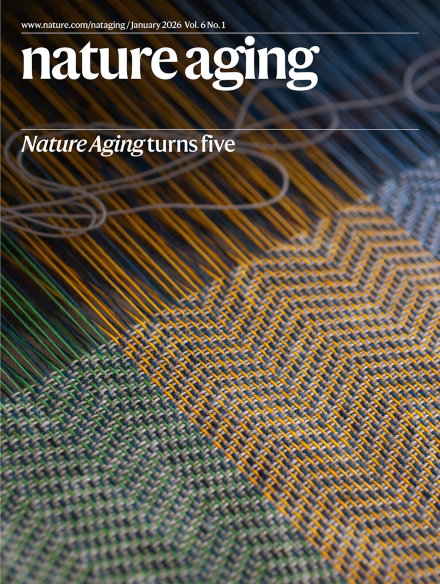
Nature Aging turns five

In this issue, Nature Aging celebrates its fifth anniversary with special content that gives a peek at what happens backstage at the journal and provides perspectives on the past and future of aging and age-related disease research. The cover image depicts a loom on which cloth is woven from multicolored threads. The roman numeral V emerges as separate threads come together to form a patterned fabric. The process of weaving represents the journal’s vision of bringing together aging research from different corners of the field.

See Editorial

Image: Tobias Titz/fStop/Getty. Cover design: Lauren Heslop
Editorial

  • As we embark on our sixth year of publication, we reflect on what the journal has achieved and highlight some of its successes. This anniversary issue also features two Q&As. One pulls back the curtain on the work of the journal’s backstage team. The other samples the thoughts and opinions of some of the many researchers who supported the journal early on, as authors, advisers or reviewers.

    Editorial

    Advertisement

Top of page ⤴

Comment & Opinion

  • Biological aging clocks predict health outcomes, including morbidity and mortality, more accurately than chronological age alone, yet defining true biological age remains contentious. We propose ‘risk-equivalent’ age as an operationally defined metric that reflects an individual’s position on a continuum of clinically meaningful risk. Reconceptualizing biological age as a dynamic, risk-based vital sign may facilitate the use of aging clocks in clinical practice.

    • Sheng Fong
    • Woon-Puay Koh
    • Jan Gruber
    Comment
  • As Nature Aging celebrates its fifth anniversary, the journal asks some of the researchers who contributed to the journal early on to reflect on the past and the future of aging and age-related disease research, the impact of the field on human health now and in the future, and what challenges need to be addressed to ensure sustained progress.

    • Fabrisia Ambrosio
    • Maxim N. Artyomov
    • Sebastien Thuault
    Q&A
  • For Nature Aging’s fifth anniversary, we acknowledge the essential work that is done by our colleagues, without which Nature Aging’s monthly publication would not be possible. We speak with some of our internal colleagues about the process of making a journal every month. Rebecca Roberts is a production editor at Springer Nature, Mark McGranaghan is a senior sub editor, Lauren Snape is an art editor and Amanda Karmolinski is a senior editorial assistant. In this Q&A, Rebecca, Mark, Lauren and Amanda pull back the curtain and tell us about the various roles that go into putting it all together.

    • Rebecca Roberts
    • Mark McGranaghan
    • Anna Kriebs
    Q&A
Top of page ⤴

Research Highlights

Top of page ⤴

News & Views

  • Two recent studies, from Shang et al. and Mejía-Ramírez et al., identify complementary mechanical mechanisms that regulate hematopoietic stem cell aging: external shear stress and internal nuclear envelope tension. These forces represent an evolutionary tradeoff between immediate immune defense and long-term stem cell maintenance.

    • Chih-Ling Wang
    • Mary Mohrin
    News & Views
  • Aging erodes the regenerative capacity of the gut, which weakens barrier function and repair. Eskiocak, Gewolb, Shah, Rouse, Chowdhury and colleagues show that senescent epithelial cells accumulate and drive this decline. Selective elimination of cells that express the senescence-associated surface marker uPAR using senolytic chimeric antigen receptor T cells restores stem cell function and rejuvenates the aged mouse gut.

    • Marina Kolesnichenko
    News & Views
Top of page ⤴

Research Briefings

  • We generated a mouse model of Alzheimer’s disease (AD) that replicates neuronal loss seen in patients, which overcomes a key barrier in the field. By reinstating the function of cyclin-dependent kinase 3 (CDK3), the model reliably exhibits human-like neurodegeneration, which opens a direct path towards evaluating CDK3 as a therapeutic target.

    Research Briefing
  • We developed scMORE (single-cell multiomics regulon enrichment), a computational framework that integrates single-cell multiomics with genome-wide association study summary statistics to identify transcription factor–chromatin–gene regulatory networks (eRegulons) that underlie complex diseases. Applying scMORE to 31 traits (including Parkinson’s disease), we investigated immune- and aging-associated eRegulons, and revealed how genetic variants shape cell-type-specific regulatory programs.

    Research Briefing
Top of page ⤴

Reviews

Top of page ⤴

Research

Top of page ⤴

Search

Quick links